Thailand has earned its reputation as the world’s top destination for meditation retreats, and the numbers back it up. Over the past year, travelers booking extended stays chose Thailand more than any other country—and for good reason.
The combination of authentic Buddhist traditions, affordable prices, and diverse retreat options makes Thailand unmatched. You can practice strict Vipassana in a northern temple, attend a luxury wellness program on a southern island, or join a silent retreat in a jungle setting. Each experience offers something different, but they all share one thing: Thailand’s deep-rooted meditation culture creates an environment that supports serious practice.
This guide focuses on one crucial decision that often gets overlooked—where you’ll stay before, during, and after your retreat. The right accommodation can make or break your experience. Stay too far from your meditation center and you’ll waste energy on logistics. Choose a loud, chaotic hotel and you’ll struggle to maintain the calm you’ve worked to build. Pick the wrong area entirely and you might miss out on the type of retreat you’re actually looking for.
We’ll walk through the five best regions for meditation retreats in Thailand: Chiang Mai for traditional Buddhist practice, Koh Samui for high-end wellness, Bangkok for convenient short courses, Koh Phangan for intensive silent retreats, and Pai for nature-based programs. Each section includes specific neighborhoods, hotel recommendations, and what makes that location work for different types of practitioners.
You’ll also find practical information on timing your bookings, choosing between budget and comfort, and planning your arrival and departure around your retreat schedule. Whether you’re coming for a weekend introduction or a month-long immersion, this guide will help you find the right place to support your practice.
Quick Guide: Best Areas for Meditation Retreats in Thailand
Before we dig into each location, here’s a straightforward comparison to help you narrow down your options. Different areas in Thailand attract different types of retreats, and matching your goals with the right region will save you time and frustration.
Comparison Table:
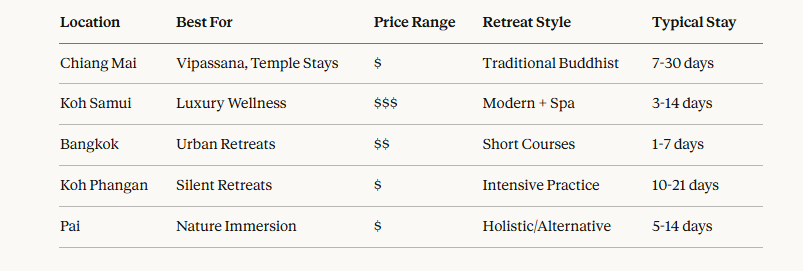
Chiang Mai dominates the traditional meditation scene. The city holds over 300 Buddhist temples, many offering genuine Vipassana instruction from experienced monks. Accommodation here ranges from $10 guesthouses to $50 boutique hotels, and you can walk to most major meditation centers from the Old City. People serious about learning authentic technique come here, often staying several weeks.
Koh Samui serves the opposite end of the spectrum. This island hosts high-end wellness resorts where meditation classes combine with yoga, spa treatments, and health-focused meals. Rooms start around $150 per night and climb from there. The retreats here work well for people who want to explore meditation without committing to the austerity of traditional practice.
Bangkok offers convenience above all else. International travelers can arrive, complete a weekend or three-day course at a reputable center, and continue their trip without heading to remote areas. The city has legitimate teaching monasteries, but the surrounding urban energy makes extended stays challenging for most practitioners.
Koh Phangan has built a reputation around serious, silent retreats. Centers here run 10-day and 21-day programs with strict rules—no talking, no eye contact, no electronics. The island itself is less developed than Koh Samui, which keeps prices reasonable and distractions minimal. Practitioners leave their phones at reception and commit fully to the schedule.
Pai attracts people looking for something gentler. This mountain town in northern Thailand has a laid-back atmosphere, and the meditation offerings reflect that. You’ll find shorter daily sessions, more flexibility, and programs that blend sitting practice with hiking, creative work, or community activities. The setting itself—rice fields, mountains, and waterfalls—becomes part of the practice.
Your choice depends on three main factors: how much structure you want, how much you’re willing to spend, and how long you plan to stay. Match those preferences to the table above and you’ll have a clear starting point. The following sections break down each location in detail, including specific neighborhoods and where to book your room.
Chiang Mai: Traditional Buddhist Meditation Hub
Chiang Mai operates as Thailand’s meditation capital. The city’s concentration of experienced teachers, authentic practice lineages, and supportive infrastructure makes it the default choice for anyone pursuing traditional Buddhist meditation.
Why Chiang Mai?
The numbers tell part of the story—over 300 Buddhist temples within city limits, dozens offering meditation instruction to foreigners. But quantity alone doesn’t explain Chiang Mai’s appeal. These temples maintain teaching lineages going back decades or centuries. Monks here learned from teachers who learned from their teachers, creating an unbroken chain of instruction in Vipassana and other Buddhist meditation techniques.
The city sits in a valley surrounded by mountains, which creates cooler temperatures than southern Thailand. From November through February, mornings and evenings require a light jacket—a welcome relief if you’re sitting for hours in a meditation hall. The cool season also coincides with the most popular retreat period, so book accommodation well ahead if you’re planning a winter visit.
Chiang Mai has absorbed thousands of digital nomads over the past decade, and that population brought infrastructure that benefits retreat participants. You’ll find excellent coffee shops, coworking spaces, healthy restaurants, and reliable internet throughout the city. This matters less during your retreat, but it makes the transition before and after much smoother.
Best Areas to Stay
Old City
The Old City sits inside the ancient moat and walls that once protected Chiang Mai. This square mile contains the highest concentration of temples, meditation centers, and guesthouses catering to practitioners. You can walk to Wat Suan Dok, Wat Chedi Luang, and Wat Phra Singh in under 20 minutes from most accommodations here.
Staying in the Old City puts you in the center of Buddhist practice. You’ll hear monks chanting at dawn, see orange-robed practitioners walking for alms, and feel the rhythm of temple life around you. The area has enough restaurants and cafes to support extended stays, but it avoids the noise and chaos of the city’s more touristy districts.
Look for guesthouses near Ratchadamnoen Road or the north gate area. These locations offer quiet rooms, basic amenities, and prices between $15-30 per night. Several properties specifically market to meditation retreat participants, which means they understand requests for early breakfast, quiet hours, and simple vegetarian meals.
Nimman (Digital Nomad Area)
Nimman sits northwest of the Old City and represents modern Chiang Mai. The neighborhood has transformed over the past five years into a hub for remote workers, with dozens of cafes, coworking spaces, and international restaurants lining the main roads.
This area works better for pre-retreat or post-retreat stays rather than during your intensive practice. The energy here is active, social, and connected—the opposite of what most meditation centers cultivate. However, Nimman offers comfortable mid-range hotels ($40-80 per night), reliable amenities, and easy access to services you might need before heading to a more remote retreat.
Many practitioners book a few nights in Nimman when they first arrive in Chiang Mai. This gives them time to adjust to the timezone, buy any supplies they forgot, and mentally prepare for the structure ahead. After completing a strict retreat, returning to Nimman provides a gentle re-entry point before jumping back into normal travel.
Doi Suthep Area
Doi Suthep mountain rises on the western edge of Chiang Mai, and its forested slopes host several meditation centers that emphasize nature immersion. These centers sit 30-45 minutes from downtown by songthaew (shared pickup truck), surrounded by jungle rather than city.
The mountain area appeals to people who want complete separation from urban life. Some centers here require participants to sleep in simple huts or even caves, following the forest monk tradition. Others offer basic rooms but maintain strict silence and minimal comfort to support intensive practice.
Accommodation options near Doi Suthep range from budget retreat centers ($5-15 per night including meals) to a few mid-range resorts that cater to visitors exploring the famous Wat Phra That Doi Suthep temple. If you’re attending a retreat on the mountain, the center itself usually provides housing. For visits outside a formal program, options become limited—this area wasn’t built for casual tourism.
Top Meditation Centers in Chiang Mai
Wat Suan Dok (International Meditation Center)
Wat Suan Dok runs a program specifically designed for foreigners interested in learning Vipassana meditation. Monks here speak English well and understand how to explain Buddhist concepts to Western students. The center offers drop-in sessions, weekend workshops, and longer retreats ranging from one week to one month.
The temple sits just outside the Old City’s western gate, making it walking distance from most Old City guesthouses. Sessions run daily, and you can attend individual sessions without committing to a full course. This flexibility makes Wat Suan Dok an excellent starting point if you’ve never practiced in a Thai temple setting.
Wat Rampoeng (Strict Vipassana)
Wat Rampoeng maintains one of Thailand’s most rigorous Vipassana programs. The minimum commitment is 10 days, but most participants stay three weeks or longer. Rules here are strict: no talking, no eye contact, no reading, no writing. You’ll meditate 12-14 hours per day following a schedule that begins at 4am.
The temple’s Northern Insight Meditation Center has trained thousands of students over several decades. Teachers use the Mahasi Sayadaw method, which emphasizes noting mental and physical phenomena as they arise. This approach produces powerful results but demands genuine commitment.
Wat Rampoeng sits about 20 minutes south of the Old City. The center provides basic accommodation and vegetarian meals as part of the program. You’ll need to apply in advance and arrive with appropriate clothing (white or light colors, loose fitting, covering shoulders and knees).
Northern Insight Meditation Center
This center operates independently from any specific temple, though it teaches the same Mahasi Sayadaw method as Wat Rampoeng. The program structure is similar—intensive daily practice with experienced teachers—but the setting feels less formal. The center occupies a quiet compound with individual meditation huts, a main hall, and simple rooms for participants.
Most people come here for 10-day or 21-day courses. The teaching staff includes both Thai monks and Western teachers who have trained extensively in this tradition. Having teachers who share your cultural background can help when working through subtle meditation experiences that are difficult to describe across language barriers.
Sample 7-Day Itinerary
Days 1-2: Settle in Old City
Arrive in Chiang Mai and book a guesthouse inside the Old City walls. Spend these first days adjusting to the timezone, exploring the area on foot, and visiting temples to get a feel for the environment. Attend a drop-in meditation session at Wat Suan Dok to experience the setting before committing to longer practice.
Use this time to buy any supplies you’ll need: comfortable loose clothing, a notebook if the center allows it, toiletries, and perhaps a meditation cushion if you have specific preferences. Visit the Saturday or Sunday walking street markets to experience Chiang Mai’s cultural side before entering silence.
Days 3-6: Temple Meditation Retreat
Begin your formal retreat at whichever center you’ve chosen. You’ll typically check in during the afternoon, receive orientation about the schedule and rules, and start practice that evening. The days will follow a set structure: wake before dawn, alternate sitting and walking meditation throughout the day, attend teachings in the evening, and sleep early.
Most centers provide all meals, usually simple vegetarian food served once or twice daily. You’ll have a private room or share with one other person, depending on the center. Expect basic conditions—a mattress on the floor, a fan, shared bathrooms. The simplicity serves the practice by removing distractions and comfort-seeking habits.
Day 7: Integration & Departure
Leave the retreat center in the morning and return to your Old City accommodation. Spend this final day moving slowly, perhaps taking a quiet walk or sitting in a cafe without immediately jumping into intense stimulation. Many practitioners find they need time to process what happened during retreat before resuming normal activity.
If you have flexibility in your schedule, consider staying an extra day or two in Chiang Mai after completing your retreat. The abrupt shift from intensive practice to travel stress can undermine some of the stability you’ve built. Give yourself space to integrate before moving to your next destination.
Koh Samui: Luxury Wellness & Meditation
Koh Samui represents the complete opposite approach to Chiang Mai’s austere temple retreats. This island in the Gulf of Thailand has built an entire industry around high-end wellness programs that package meditation with spa treatments, gourmet health food, yoga classes, and beachfront settings.
Why Koh Samui?
The island’s wellness resorts attract people who want to explore meditation without abandoning comfort. You’ll sleep in air-conditioned rooms with ocean views, eat carefully prepared meals that somehow taste indulgent while remaining healthy, and have access to massage therapists, fitness trainers, and wellness consultants throughout your stay.
This approach works particularly well for people new to meditation. The resort environment reduces the intimidation factor—you’re not showing up alone at a Thai temple trying to figure out unfamiliar customs. English-speaking staff walk you through everything, schedules remain flexible enough to accommodate your energy levels, and if sitting meditation feels too challenging one day, you can attend a yoga class instead.
Koh Samui also solves the logistics problem that stops many people from attending traditional retreats. Getting to a remote temple in northern Thailand requires research, planning, and tolerance for uncertainty. Flying into Koh Samui, booking a resort online, and showing up for a pre-arranged program requires minimal effort. You sacrifice authenticity for convenience, but that trade-off makes sense for certain travelers.
The island maintains year-round accessibility. Unlike northern Thailand, which becomes uncomfortable during the hot season, Koh Samui’s tropical climate stays relatively consistent. The rainy season (October-December) brings afternoon storms but rarely disrupts activities. Peak season runs from January through August, with corresponding price increases.
Best Areas to Stay
Lamai Beach
Lamai sits on the island’s east coast, south of the more famous Chaweng Beach. The area has developed specifically around wellness tourism, with several major retreat centers clustered within a few kilometers. This concentration creates a community of health-focused travelers, and local businesses cater to that demographic.
The beach at Lamai stretches long and relatively quiet compared to Chaweng’s party scene. You can walk for 20-30 minutes along the sand without encountering aggressive vendors or loud beach clubs. Several wellness resorts front directly onto the beach, giving you immediate access to swimming and walks as part of your routine.
Accommodation prices in Lamai start around $80 per night for basic beachfront hotels and climb to $300+ for rooms at the major wellness resorts. Most retreat programs include lodging in their package price, which typically runs $150-400 per night depending on the program intensity and accommodation level you choose.
Bophut
Bophut occupies the northern coast and maintains a more refined atmosphere than other beach areas. The neighborhood centers on the Fisherman’s Village, a collection of restored shophouses that now hold boutique hotels, upscale restaurants, and art galleries. Thursday evenings bring a walking street market that avoids the tourist chaos of similar markets elsewhere on the island.
This area appeals to people who want beach access but prefer a quieter, more sophisticated environment. Several smaller wellness hotels operate in Bophut, offering 5-10 room properties with personalized service and intimate group sizes. You’ll pay more here than in Lamai—rooms start around $120 per night—but the tradeoff comes in atmosphere and attention to detail.
Bophut works well if you’re booking a wellness retreat but your travel partner isn’t. They can enjoy the beach, restaurants, and village atmosphere while you attend programs, and you’ll both have comfortable common ground during off hours.
Maenam
Maenam runs along the north coast west of Bophut. The beach here extends for several kilometers, backed by palm trees and local Thai restaurants rather than resort development. This area maintains the most local character of the three neighborhoods, with Thai families living alongside the smaller number of tourists who discover it.
A few wellness properties operate in Maenam, generally at lower price points than Lamai or Bophut. You’ll find converted villas offering yoga and meditation classes, plus smaller boutique hotels with wellness programs. The setting here feels less polished but more authentic, and you’ll interact with actual island residents rather than just other wellness tourists.
Maenam suits people planning longer stays—a month or more—who want to practice meditation while living somewhat normally. You can rent a scooter, shop at local markets, eat at neighborhood restaurants, and attend occasional meditation sessions rather than committing to an all-consuming program. Monthly accommodation costs drop significantly here, with some properties offering rooms for $500-800 per month.
Top Meditation & Wellness Centers
Kamalaya Wellness Sanctuary
Kamalaya represents the top end of Koh Samui’s wellness scene. The property sprawls across a hillside south of Lamai, with individual pavilions connected by jungle paths, a hilltop meditation sala with ocean views, and treatment rooms built into natural cave formations. The place feels more like a high-end resort than a meditation center, which is exactly the point.
Programs here combine meditation instruction with massage, detox protocols, fitness training, and nutritional counseling. You’ll attend guided meditation sessions twice daily, but you’re also encouraged to book spa treatments, work with wellness consultants, and participate in yoga or Pilates classes. The meditation component provides a foundation, but the overall program addresses multiple aspects of health.
Rates start around $400 per night including accommodation, meals, and wellness activities. Specialized programs (stress relief, emotional healing, detox) run for 5-14 days and cost $3,000-10,000+ depending on length and services included. The price reflects the level of service—you’ll have a personal wellness coordinator, customized meal plans, and access to experienced practitioners in various healing modalities.
Samahita Retreat
Samahita takes a more structured approach than Kamalaya. The center sits right on Lamai Beach and runs specific programs focused on yoga and meditation practice. The atmosphere is less spa-like and more dedicated to actual technique training. Classes run longer and dig deeper into both physical and mental practice.
Programs here last 7-14 days and follow a set schedule: morning meditation and yoga, healthy meals, afternoon sessions, evening classes. You’ll work with experienced teachers who have trained extensively in both yoga and Buddhist meditation traditions. The center maintains some flexibility—you can skip sessions if you need rest—but the expectation is that you’ll participate fully.
Rooms at Samahita range from shared accommodations to private beachfront suites. Package prices run $150-300 per night including meals and all classes. The center attracts people who have some experience with yoga or meditation and want to deepen their practice in a supportive environment without the full intensity of a silent retreat.
Absolute Sanctuary
Absolute Sanctuary focuses specifically on detox and wellness programs, with meditation and yoga serving as supporting elements. The center has built a reputation around juice fasting, colonic hydrotherapy, and other cleansing protocols. Meditation here helps participants work with the mental and emotional material that surfaces during physical detoxification.
This approach appeals to people primarily interested in physical health who recognize the mind-body connection. The meditation instruction is solid but not the primary focus. You’ll learn basic techniques, have time for daily practice, and receive guidance on maintaining awareness during the detox process, but you won’t dive into intensive concentration training.
Programs run 3-14 days with prices from $200-350 per night including detox protocols, meals (or juices), and wellness classes. The property sits just off Lamai Beach in a quiet area designed to support rest and internal processing. Rooms are comfortable and clean without being luxurious—the emphasis is on function rather than indulgence.
Sample 5-Day Wellness Itinerary
Day 1: Arrival & Assessment
Arrive at Koh Samui airport and transfer to your chosen wellness resort (most provide airport pickup). Check in during the afternoon and meet with your wellness coordinator to discuss your goals and any health concerns. Attend an orientation session covering the facility, schedule, and program overview.
Have an early, light dinner and attend an evening meditation session. The first session will introduce you to the center’s approach and give you a taste of what’s ahead. Return to your room early to adjust to the environment and prepare for the full schedule beginning the next morning.
Day 2-4: Full Program Days
Wake before sunrise for morning meditation practice, typically 60-90 minutes of guided sitting. Follow this with yoga or movement classes, then breakfast featuring fresh fruit, smoothies, and healthy options. Spend mid-morning at leisure—swimming, reading, resting in your room, or booking a spa treatment.
Attend afternoon meditation or yoga sessions, usually shorter than morning practice (30-60 minutes). Have time before dinner for another swim or walk on the beach. Evening programming might include meditation, gentle yoga, talks on wellness topics, or free time to rest.
Each day builds on the previous one. Early sessions might feel challenging as your mind adjusts to slowing down, but by day three or four, most people settle into the rhythm. The combination of meditation, physical activity, healthy food, and ocean environment creates a tangible shift in how you feel.
Day 5: Integration & Departure
Your final morning follows the regular schedule—meditation, yoga, breakfast. Use the afternoon to pack, have a final treatment or meditation session, and prepare for departure. Many centers offer a closing session where you can ask questions about maintaining practice at home.
Most people leave Koh Samui’s wellness programs feeling refreshed but not fundamentally transformed. The experience introduces meditation in a comfortable setting and demonstrates how combining multiple wellness practices creates greater effects than any single element alone. Think of it as a foundation you can build on rather than a complete restructuring of your practice.
Bangkok: Urban Meditation Retreats
Bangkok doesn’t seem like an obvious meditation destination. The city sprawls across 1,500 square kilometers of concrete, traffic, and constant noise. Temperatures hover around 32-35°C most of the year with humidity that makes you sweat just standing still. Yet Bangkok hosts some of Thailand’s most accessible and well-organized meditation programs for international visitors.
Why Bangkok?
The main advantage is simple: you’re probably passing through anyway. Bangkok serves as Thailand’s primary international gateway, and rather than immediately escaping to beaches or mountains, you can use the city as your introduction to Thai meditation practice.
Several Bangkok temples run drop-in programs and short courses specifically designed for foreigners. These programs accommodate people with limited time and no prior experience. You can attend a single evening session, complete a weekend workshop, or commit to a three-day intensive without traveling beyond the city.
Bangkok’s meditation centers also tend to have stronger English-language instruction than provincial temples. Monks and lay teachers here have worked with thousands of foreign students and know how to explain concepts clearly. They understand common questions, recognize when students are confused, and can adjust their teaching style to match different backgrounds.
The city allows you to test meditation practice before committing to something more intensive. If you discover sitting still for hours doesn’t work for you, you’ve only invested a weekend. If you find it valuable, you can plan a longer retreat elsewhere in Thailand during a future trip.
Best Areas to Stay
Sukhumvit
Sukhumvit Road runs through central Bangkok for over 20 kilometers, and the neighborhoods along it contain most of the city’s international hotels, restaurants, and services. This area has become the default base for foreign visitors who want modern amenities and easy transportation access.
Staying in Sukhumvit means you’ll have the BTS Skytrain within walking distance, which makes reaching meditation centers across the city straightforward. The neighborhood has every type of accommodation from $20 hostels to $200 hotels. Most properties cater to international guests, so staff speak English and understand foreign preferences.
The energy here is active and commercial. Sukhumvit doesn’t provide the peaceful environment ideal for meditation, but it works well for short trips where you’re balancing retreat attendance with other activities. You can attend morning and evening meditation sessions at a temple, then return to a comfortable room with air conditioning and reliable wifi.
Look for hotels near BTS stations—Asok, Phrom Phong, or Thong Lo all work well. These locations put you within 20-30 minutes of major meditation centers by train or taxi. Prices vary wildly depending on exact location and hotel standard, but expect $40-80 per night for decent mid-range options.
Old Bangkok (Rattanakosin)
Rattanakosin represents historic Bangkok—the area around the Grand Palace, Wat Pho, and the Chao Phraya River. This district holds the city’s most important temples and maintains more traditional Thai character than modern business districts.
Staying here puts you within walking distance of Wat Mahathat, Bangkok’s most respected meditation center for foreigners. You can attend morning and evening sessions without dealing with traffic or long commutes. The area also contains Wat Phra Kaew, Wat Arun, and dozens of other temples worth visiting if you have extra time.
Accommodation options in Rattanakosin tend toward budget guesthouses and a few mid-range hotels. The neighborhood gets hot and crowded during the day when tourists flood the major temples, but early mornings and evenings become quiet. Rooms cost $15-50 per night, generally simpler than equivalent prices in Sukhumvit but with more authentic atmosphere.
The lack of modern infrastructure here might frustrate some visitors. Fewer restaurants cater to foreign tastes, English becomes less common, and you’ll need to use taxis or river boats rather than the BTS. But if your primary goal is meditation practice with some cultural exploration, Rattanakosin works better than more developed areas.
Riverside
The Chao Phraya River cuts through Bangkok, and the neighborhoods along both banks offer a different experience than inland areas. Several upscale hotels occupy riverside locations, taking advantage of views and river breeze to create calmer environments within the chaotic city.
This area works best if you have a larger budget and want Bangkok accommodation that doesn’t feel completely urban. You’ll still be in the city center with access to meditation centers, but your hotel will provide a buffer against the intensity. River ferries run frequently and connect to the BTS system, making transportation straightforward.
Hotels here start around $80 per night and climb to $300+ for luxury properties. The premium buys you space, views, and amenities that make short stays more pleasant. Many riverside hotels also have spas, pools, and restaurants that help you transition between meditation sessions and regular travel activities.
Top Centers
Wat Mahathat (Vipassana Section 5)
Wat Mahathat sits near Thammasat University in the Rattanakosin area. The temple complex is large and active, but Section 5 operates specifically as an international meditation center. The program here has run continuously for over 50 years and has taught thousands of foreign students.
Classes happen twice daily—one session at 7am, another at 6pm. Each session lasts about two hours, including sitting meditation, walking meditation, and instruction from experienced teachers. You can attend single sessions as a drop-in visitor or commit to attending regularly for several days or weeks.
The teaching method focuses on practical Vipassana technique. Teachers emphasize direct observation of physical sensations and mental activity without getting caught in philosophy or belief. Instructions are clear, corrections are specific, and the overall approach assumes you’re here to learn actual skill rather than absorb Buddhist culture.
The center charges no fee but accepts donations. You’ll sit in a large open hall with other students, some Thai and some foreign. The atmosphere is serious but not oppressive—teachers recognize that learning meditation takes time and mistakes are part of the process. After sessions, you can ask questions individually or join group discussions.
House of Dhamma
House of Dhamma operates as a dedicated meditation center rather than part of a temple complex. The facility sits in a quiet area north of central Bangkok and offers both daily drop-in sessions and longer residential courses. Most foreigners come here for three-day or seven-day intensive programs.
The teaching follows the Mahasi Sayadaw tradition, the same method used at Wat Rampoeng in Chiang Mai but adapted for shorter timeframes. You’ll practice noting technique, interview with teachers twice daily, and maintain silence throughout the program. The schedule runs from 4am wake-up through 9pm, with alternating sitting and walking meditation filling most of the day.
Residential courses include basic accommodation and vegetarian meals. Rooms are simple—a mattress, fan, and shared bathroom facilities. The center provides these at no cost but expects you to maintain precepts and follow the schedule exactly. This isn’t a flexible program where you can skip sessions or check your phone during breaks.
House of Dhamma works well for people who want to experience intensive retreat practice but can’t commit to 10+ days. Three days provides enough time to get past initial resistance and taste what sustained practice produces, but won’t completely upend your travel schedule.
International Buddhist Meditation Center
The International Buddhist Meditation Center runs programs at Wat Phra That, a temple in Bangkok’s Thonburi district across the river from the main city center. The center offers weekend workshops, five-day courses, and occasional longer programs throughout the year.
Teaching here covers multiple meditation approaches including concentration practice, mindfulness, and loving-kindness meditation. The program is less intensive than House of Dhamma and more structured than Wat Mahathat’s drop-in sessions. You’ll have scheduled sitting and walking periods, Dhamma talks, question and answer sessions, and some free time.
The center maintains a slightly more relaxed atmosphere than stricter Vipassana programs. Students can speak during meals and breaks, ask questions openly during sessions, and adjust the practice somewhat to their needs. This flexibility makes the center appealing to beginners who want structure without overwhelming intensity.
Weekend and five-day programs include simple accommodation and vegetarian meals. The center requests a donation to cover costs—typically $20-30 per day—but no one is turned away for inability to pay. Most participants are foreign tourists combining meditation training with Bangkok sightseeing.
Sample 3-Day Weekend Retreat
Friday Evening: Arrival
Check into your hotel in Sukhumvit or Rattanakosin area during the afternoon. Get settled, have an early dinner, and head to your chosen meditation center for evening orientation. Most centers ask you to arrive by 6pm on the first day for registration and introduction to the facilities.
Receive basic instructions on sitting posture, walking meditation, and the schedule ahead. Complete a short practice session—perhaps 30-45 minutes—to get familiar with the setting. Return to your hotel and sleep early. The full schedule starts before dawn, and you’ll want rest.
Saturday-Sunday: Full Practice Days
Wake at 4:30am and arrive at the center by 5am. Begin with sitting meditation for 45-60 minutes, followed by walking meditation, then another sitting. Breakfast around 7:30am, usually rice soup or simple vegetarian food. Continue alternating sitting and walking meditation through the morning with short breaks between sessions.
Lunch happens around 11am or noon and serves as the day’s main meal. Some strict programs follow the Buddhist precept of not eating after noon, while others offer light snacks or drinks in the evening. Rest period after lunch allows you to sleep, walk, or sit quietly in your room.
Afternoon practice resumes around 1pm or 2pm and continues until dinner time (or evening drink time if following the no-afternoon-meal practice). Evening sessions include a Dhamma talk from a senior teacher, usually covering practical aspects of meditation or basic Buddhist philosophy relevant to practice.
Interview with a teacher once or twice daily to report your experience and receive specific guidance. These meetings last 5-10 minutes and focus on technique rather than abstract discussion. Teachers want to know what you’re actually experiencing and whether you’re practicing correctly.
Monday Morning: Departure
Final morning session follows the regular schedule. After breakfast, pack your belongings and complete any final interviews or discussions with teachers. Most centers offer a closing session where students can ask questions about maintaining practice at home.
Leave the center by mid-morning and return to your hotel or continue with travel plans. The three-day format provides enough exposure to understand what meditation practice involves without requiring major schedule adjustments. You’ll leave with basic technique and can decide whether longer retreats interest you for future trips.
Koh Phangan: Silent & Intensive Retreats
Koh Phangan has a strange dual identity. The southern part of the island hosts Full Moon Parties—monthly gatherings where thousands of backpackers drink buckets of alcohol and dance on the beach until sunrise. The northern part hosts silent meditation retreats where participants surrender their phones, avoid eye contact, and maintain complete silence for 10-21 days.
These two worlds rarely overlap. People come to Koh Phangan for one or the other, and the island’s geography keeps them separated. If you’re here for meditation, you’ll barely notice the party scene exists.
Why Koh Phangan?
Koh Phangan specializes in a specific type of retreat: long, silent, intensive programs with strict rules and minimal comfort. Several centers on the island have built reputations for running legitimate 10-day and 21-day courses that follow traditional Vipassana or Buddhist meditation formats.
The island’s relative isolation helps create the container needed for intensive practice. Koh Phangan is harder to reach than Koh Samui—you’ll take a ferry from the mainland or from Samui itself. This extra travel barrier filters out casual tourists and creates an environment where people come with serious intention.
Prices on Koh Phangan remain significantly lower than Koh Samui despite similar beach and tropical settings. Accommodation costs $10-25 per night outside of retreat programs, and most retreat centers include lodging and meals for $15-40 per day. This affordability makes extended stays practical even for budget travelers.
The island also maintains a wellness community that extends beyond individual retreat centers. People who come for 10-day programs often stay extra weeks or months, renting simple bungalows and practicing informally. Yoga studios, healthy cafes, and healing practitioners cluster in certain areas, creating a support network for ongoing practice.
Best Areas to Stay
Haad Salad
Haad Salad occupies the northwest coast and hosts several of the island’s main meditation centers. The beach here curves in a protected bay with calm water and minimal development. A few restaurants and small resorts line the road, but the area maintains a quiet atmosphere compared to southern beach towns.
Staying near Haad Salad makes sense if you’re attending a retreat in this area. You can arrive a day or two early to adjust to the island, walk the beach, and mentally prepare for the structure ahead. After completing your retreat, you can extend your stay in the same area without traveling.
Accommodation options range from basic beach bungalows ($10-15 per night) to slightly nicer resorts ($30-50). Most properties are simple—a bed, fan, cold water shower, and not much else. The lack of amenities is intentional; this area attracts people who want minimal distraction and maximum quiet.
Several walking trails lead from Haad Salad into the jungle and to neighboring beaches. These paths give you options for gentle movement and nature exposure during pre-retreat or post-retreat days when you’re not yet traveling but need something besides sitting in a room.
Srithanu
Srithanu sits on the west coast and has evolved into Koh Phangan’s wellness hub. The area contains numerous yoga studios, vegetarian restaurants, healing centers, and small retreat spaces. The community here is international, health-focused, and tends toward longer stays rather than quick tourism.
This area works better for people planning to stay on the island for several weeks or months rather than attending a single intensive retreat. You can rent a monthly bungalow ($200-400), attend drop-in yoga and meditation classes, eat at community-oriented cafes, and connect with other practitioners.
Srithanu has a definite scene—everyone seems to be teaching something, healing something, or training in something. Some people find this supportive and inspiring; others find it excessive. The advantage is you’ll never lack for classes, workshops, or practice partners if you want them.
Beach access at Srithanu is limited. The coast here is rocky with limited sand, and most people swim at nearby beaches or use hotels’ pools. The focus is on practice and community rather than classic beach vacation activities.
Thong Sala
Thong Sala serves as Koh Phangan’s main town and ferry port. Everyone arrives here, but few people stay. The town exists primarily for logistics—banks, ATMs, shops, clinics, and transportation connections. The setting is functional rather than peaceful, with constant traffic from scooters and pickup trucks.
Staying in Thong Sala makes sense for one night when you first arrive, particularly if your retreat center is elsewhere on the island and you’re arriving late in the day. Several budget guesthouses near the pier charge $10-20 per night and provide basic rooms for travelers in transition.
After completing a retreat, you might stay one final night in Thong Sala before catching a morning ferry to the mainland. This puts you near the departure point and lets you handle any last-minute tasks—buying supplies, getting cash, making travel arrangements—before leaving the island.
Don’t expect peace or natural beauty in Thong Sala. This is where island residents shop, where tourists arrive confused and leave hungover, and where practical necessities happen. Stay here only when logistics require it, not as a base for meditation practice.
Top Centers
Wonderland Healing Center
Wonderland runs 10-day and 21-day silent retreats based on Vipassana technique combined with some healing and yoga elements. The center occupies jungle property near Haad Salad, with individual huts for participants, a main meditation hall, and treatment spaces for massage and bodywork.
The program maintains silence and separation between participants but incorporates more flexibility than traditional Goenka-style Vipassana. You’ll meditate 8-10 hours daily rather than 12, and the schedule includes yoga classes and optional healing sessions. Some practitioners appreciate this gentler approach; purists prefer stricter programs.
Wonderland attracts a mixed group—some experienced meditators, some complete beginners, some people primarily interested in healing work who add meditation as a secondary element. This creates less intensity than centers where everyone shares serious practice commitment, but it also reduces intimidation for newcomers.
The 10-day program costs around $400-500 including accommodation, vegetarian meals, and all sessions. Private huts with your own bathroom cost more; shared facilities cost less. The center books months in advance during peak season (December-March), so reserve early if you have fixed travel dates.
Samma Karuna
Samma Karuna maintains a stricter approach than Wonderland. The center runs 10-day courses following the Mahasi Sayadaw noting technique with minimal deviation from traditional format. You’ll maintain complete silence, practice 12+ hours daily, and follow the full schedule without options for yoga classes or healing sessions.
Teachers here have trained extensively in Burma and Thailand. They understand the technique deeply and can guide students through subtle territory that arises during intensive practice. Interviews happen twice daily and focus exclusively on meditation experience—what you’re noticing, where attention is going, what obstacles are appearing.
The center charges on a donation basis, requesting $25-35 per day to cover costs but accepting whatever students can offer. Accommodation is simple: small rooms or shared dormitories, cold water showers, basic vegetarian meals. The emphasis is entirely on practice rather than comfort.
Samma Karuna accepts students only after reviewing their application. The center wants to ensure people understand what they’re signing up for and have genuine interest in this specific practice approach. If you’re uncertain whether you can maintain silence and intensive schedule for 10 days, this probably isn’t your starting point.
Orr Shalom
Orr Shalom offers a different approach than traditional Vipassana centers. The program combines silent meditation with expressive practices—movement, sound work, emotional release, and group processes. Sessions alternate between stillness and expression, teaching students to access both states.
This format appeals to people who find purely silent sitting too suppressive or who carry significant unprocessed emotional material. The combination of structure and expression creates space for difficult feelings to surface and move through rather than just being observed in silence.
Programs run 7-14 days with prices around $50-70 per day including accommodation and meals. The center maintains silence during certain periods but allows speaking during group processes and meals. Participants share rooms in jungle bungalows, creating more community feeling than centers where everyone practices in complete isolation.
Teachers at Orr Shalom come from various backgrounds—Buddhist meditation, somatic therapy, tantra, and other consciousness practices. The eclecticism bothers some people who prefer traditional lineages, but others appreciate the integration of multiple approaches. Know what you’re looking for before choosing this option.
Sample 10-Day Silent Retreat Plan
Day 0: Arrival & Preparation
Arrive on Koh Phangan via ferry, either from the mainland (Surat Thani) or from Koh Samui. Transfer to accommodation near your retreat center and spend the afternoon settling in. Walk the beach, eat a good meal, charge your electronics, and handle any final communication before surrendering your phone.
Centers typically ask you to arrive the evening before your retreat starts for registration and orientation. You’ll receive your schedule, learn the facility layout, meet teachers briefly, and hear the full set of rules. Sleep early—the schedule begins before 5am and you want to start rested.
Days 1-3: Breaking Through Resistance
The first three days of silent retreat typically feel the hardest. Your mind rebels against the structure, your body hurts from sitting, and you question why you signed up for this. Everyone experiences this phase—it’s the natural friction of shifting from normal activity to sustained inward attention.
You’ll wake around 4:30am, complete morning ablutions, and begin sitting meditation by 5am. Sessions alternate between sitting (45-60 minutes) and walking meditation (30-45 minutes) with short breaks every few hours. Breakfast around 7:30am, lunch at 11:30am, no solid food after noon except perhaps fruit or tea.
Teachers conduct individual interviews once or twice daily. You’ll describe what you’re experiencing—physical sensations, mental states, challenges in maintaining attention. Teachers provide specific instructions based on your report. These meetings are brief and practical, not therapy sessions or philosophical discussions.
Days 4-7: Deepening Practice
Somewhere around day four or five, something shifts. The external struggle lessens and practice begins revealing more subtle territory. Concentration strengthens, awareness becomes more continuous, and you start noticing patterns in how your mind operates that were invisible before.
This phase is why people attend intensive retreats. The sustained practice allows access to states and insights that don’t appear during occasional meditation sessions at home. You’re not trying to achieve anything specific, but the conditions created by silence, structure, and continuous practice produce natural deepening.
Physical discomfort often decreases during this period as your body adapts to long sitting. Mental restlessness may continue or even intensify—seeing how your mind actually works can be uncomfortable. Teachers help you work with whatever arises without getting overwhelmed or creating problems from the content.
Days 8-9: Integration
The final days of retreat shift toward integration. You’re still practicing intensively, but you’re also beginning to look toward re-entry into normal life. How will you maintain what you’ve learned? What aspects of practice can continue at home? What shifts do you want to preserve?
Teachers may give guidance on post-retreat practice, suggesting schedules or techniques that match your experience level. Some centers reduce sitting time slightly on the final day to help students transition. The strict rules remain in place until the official end, but the energy shifts toward completion.
Day 10: Emergence & Departure
The final morning includes a closing ceremony where noble silence ends and students can speak again. Most people feel simultaneously relieved and protective of the quiet space they’ve inhabited. The first conversations often feel strange—voices sound loud, small talk seems meaningless.
Centers usually provide lunch on the final day and ask students to leave by mid-afternoon. Don’t immediately rush off the island. Book at least one night nearby to decompress before traveling. Your nervous system needs time to adjust from intensive inward focus to external engagement. Pushing straight into travel stress undermines some of what you’ve built.
Pai: Nature-Based Meditation Retreats
Pai sits in a mountain valley three hours north of Chiang Mai by a winding road that makes half the passengers carsick. The town has about 2,500 residents but hosts several times that number in visitors during peak season. Most come for the scenery—waterfalls, hot springs, rice paddies framed by mountains—but a subset arrives specifically for the gentler style of meditation retreats available here.
Why Pai?
Pai represents an alternative to both strict temple practice and luxury wellness resorts. The retreats here tend toward shorter daily sessions, more flexible schedules, and integration of other activities like hiking, creative work, or community gatherings. You’ll still learn legitimate meditation technique, but the container is less rigid.
This approach works for people who want to develop a meditation practice without committing to monastic-level intensity. Maybe you’re interested in meditation but also want to explore the surrounding nature. Maybe you need time to write, paint, or process something in your life, and meditation serves as one tool among several. Pai’s centers accommodate this broader definition of retreat.
The town itself has developed a distinct culture over the past two decades. What started as a quiet mountain village discovered by backpackers has evolved into a semi-permanent community of long-term travelers, digital nomads, artists, and people recovering from something. This creates an unusual mix—locals farming rice alongside visitors teaching yoga or running cafes.
The climate in Pai is cooler than most of Thailand, particularly during the November-February period when temperatures drop enough at night to require blankets. This makes sitting meditation more comfortable than in tropical heat. The surrounding landscape provides natural settings for walking meditation and contemplative time outdoors.
Best Areas to Stay
Pai Town Center
The town center occupies less than one square kilometer but contains most of Pai’s restaurants, guesthouses, shops, and services. Walking Street runs through the middle and closes to vehicles each evening, transforming into a market with food stalls, crafts, and live music.
Staying in town gives you access to everything within a 10-15 minute walk. You can attend meditation sessions at centers just outside town, return to your guesthouse for rest, walk to restaurants for meals, and connect with other travelers if you want social contact. This balance works well for people who want retreat time but not total isolation.
Accommodation in central Pai ranges from $8-12 dorm beds to $20-40 private rooms in guesthouses. Most places are basic but clean, with shared or private bathrooms depending on what you pay. Some properties specifically advertise quiet atmospheres and attract wellness-focused guests rather than party travelers.
The main drawback is noise. While Pai is quiet compared to Bangkok or southern beach towns, the town center still has scooter traffic, music from bars, and general activity. If you’re highly sensitive to sound or need complete silence to sleep, look at areas outside town.
Outside Town (Rice Fields)
Properties scattered through the rice fields surrounding Pai offer more space and quiet than in-town guesthouses. Small resorts and bungalow operations sit among the paddies, connected to town by dirt roads. Some are walking distance from the center; others require a scooter or bicycle.
These locations provide direct access to nature. You can walk out your door into rice fields, follow irrigation channels to nearby villages, and experience rural Thai life alongside your meditation practice. The absence of urban sounds makes it easier to maintain the quiet mind-state that meditation develops.
Prices in rice field areas run slightly higher than basic town guesthouses—$25-50 per night for private bungalows with decent amenities. Many properties have gardens, outdoor sitting areas, and mountain views that create peaceful environments. Some offer yoga classes or have meditation spaces on-site.
The tradeoff is convenience. You’ll need transportation to reach restaurants, shops, and some meditation centers. Renting a scooter costs $5-7 per day and solves this problem, but not everyone feels comfortable on two wheels navigating dirt roads. Bicycles work but limit your range in Pai’s hilly terrain.
Top Centers & Offerings
Pai Vipassana Center
This center runs traditional 10-day Vipassana courses in the S.N. Goenka tradition—the same format taught worldwide through Dhamma.org. The center occupies forested property about 6 kilometers outside Pai town, completely separate from tourist areas.
The program follows strict guidelines: complete silence, no reading or writing, no contact between male and female students, meditation from 4:30am to 9pm daily. You’ll follow recorded instructions from Goenka supplemented by interviews with assistant teachers who have completed multiple courses.
This is not a nature retreat or a gentle introduction to meditation. It’s the same intensive Vipassana program offered at centers globally, and it makes no concessions to Pai’s relaxed atmosphere. The location in Pai simply provides mountain setting and cooler temperatures than retreats in central Thailand.
Courses run on donation basis with no charge for instruction, accommodation, or food. You pay only what you can afford at the end if the course helped you. The center books months ahead, so register early through their website if you want to attend during peak season.
Mountain Meditation Center
This smaller center offers 5-7 day programs that combine sitting meditation with walking meditation in nature. The approach is less formal than traditional Vipassana—you’ll maintain silence but have flexibility in your schedule, attend daily group sessions but also practice independently on forest trails.
Teachers here come from various Buddhist lineages and adapt instruction to students’ backgrounds. Someone new to meditation receives different guidance than someone with years of practice. The emphasis is on learning sustainable technique you can actually maintain at home rather than pushing through intensity you can’t replicate later.
Programs cost $30-40 per day including simple accommodation and vegetarian meals. The center holds small groups—usually 6-12 people—which allows more individual attention than large courses. You’ll have a basic room in a shared building, cold water showers, and communal meals where brief conversation is permitted.
The mountain setting itself becomes part of practice. You can sit in the main hall, walk meditation paths through the forest, or find quiet spots to practice individually. The integration of indoor and outdoor practice helps people who find continuous indoor sitting difficult.
Pai Healing Retreats
Several small operations around Pai offer 3-5 day programs combining meditation with other healing modalities. These aren’t traditional Buddhist centers but rather wellness spaces created by long-term residents offering what they’ve learned from various traditions.
Programs might include morning meditation, yoga or movement classes, workshops on breathwork or sound healing, creative activities like painting or journaling, and time for individual reflection. The meditation component provides grounding and centering, but it’s not the exclusive focus.
These programs appeal to people exploring consciousness and healing broadly rather than committing to a single practice path. You’ll learn basic meditation technique and might discover it resonates enough to pursue further, or you might find other modalities work better for you. The eclectic approach allows experimentation.
Prices run $50-80 per day including accommodation, meals, and all activities. Quality varies significantly depending on who’s running the program. Look for facilitators with legitimate training and experience rather than people who completed one retreat themselves and immediately started teaching. Ask questions about their background before committing.
Sample 7-Day Nature Retreat
Day 1: Arrival & Orientation
Arrive in Pai by bus or minivan from Chiang Mai (3-hour journey through mountains). Book into accommodation either in town or in the rice fields depending on your preference for convenience versus quiet. Spend the afternoon exploring—walk to the canyon overlook, visit a waterfall, or simply rest after the winding journey.
Attend an orientation session at your retreat center in the late afternoon or evening. Meet teachers and other participants, learn the basic schedule, and receive initial meditation instructions. Return to your accommodation and prepare for the full schedule beginning the next morning. Sleep early to adjust to the rhythm ahead.
Days 2-3: Establishing Rhythm
Wake early and arrive at the center by 6:30am for morning meditation. Sessions begin with 30-45 minutes of sitting practice, usually guided instruction focusing on breath awareness or body scanning. Follow this with walking meditation outdoors if weather permits—slow, deliberate steps on forest paths while maintaining awareness.
Return to the main hall for tea and light breakfast around 8:30am. Centers in Pai tend to allow minimal conversation during meals, recognizing that complete silence for beginners can create tension rather than ease. Have enough quiet to stay somewhat inward while not feeling completely isolated.
Mid-morning includes another sitting session, shorter than the first—perhaps 20-30 minutes. Then free practice time where you can continue sitting, walk in nature, or rest in your accommodation. The flexibility here differs from strict retreat formats and allows you to learn what balance works for you.
Lunch around noon provides the main meal—vegetarian Thai food, simple and nourishing. Afternoon includes one more group session, then extended free time for individual practice or exploration. You might hike to a nearby viewpoint, practice by a stream, or simply sit in your room observing your experience.
Evening session brings the group together around 5pm for sitting practice and a teaching talk. Teachers here usually offer practical guidance on working with common meditation challenges rather than formal dharma talks. Topics might include dealing with restlessness, finding comfortable posture, or understanding the difference between concentration and awareness.
Days 4-5: Deepening Connection
By the middle of the week, you’ve established familiarity with the routine and can practice with less external guidance. Morning sessions continue as structured, but you’ll need less detailed instruction and can work more independently during free periods.
These days often include small group discussions where participants share challenges and insights. This peer learning helps you recognize that everyone experiences similar obstacles—physical discomfort, wandering mind, doubt about whether it’s working. Hearing others describe the same difficulties makes your own experience feel less problematic.
Nature walks become more contemplative as your mind settles. Walking the same trail you hiked on day one reveals details you missed when your attention was scattered. This demonstrates how meditation practice affects perception even during ordinary activities—you’re not just learning to sit still, you’re training attention that carries into everything.
Some centers offer optional activities during these middle days—perhaps a visit to local hot springs, an evening at the night market in town, or a yoga class. These light external activities provide contrast to inward practice and help prevent the tight, effortful quality that sometimes develops when people try too hard to be “good” at meditating.
Days 6-7: Integration & Closure
The final days shift toward practical integration. How will you continue practicing after leaving? What schedule is realistic given your actual life circumstances? Teachers help you design an approach that matches your situation rather than prescribing ideals you’ll abandon within a week.
The group might take a longer nature walk together, practicing silent walking meditation through rice fields or to a waterfall. This communal activity creates closure and demonstrates that practice doesn’t require special settings—you can maintain awareness anywhere.
Final evening includes a closing circle where participants can share reflections if they choose. Most people feel some sadness that the retreat is ending mixed with readiness to return to regular life. This combination is natural—you’ve created something valuable in this temporary container, and now you’ll discover what parts transfer to normal circumstances.
Post-Retreat: Exploring Pai
After completing your retreat, stay in Pai for a few extra days rather than immediately rushing to your next destination. The town offers enough to occupy time without overwhelming your settled state. Visit remaining waterfalls and viewpoints, eat at different restaurants, sit in cafes with a book, or connect with other travelers you’ve met.
This transition period helps bridge intensive practice and regular travel. You’re no longer in formal retreat but not yet back in full activity mode. Many people find this gradual re-entry preserves more of what they gained than abrupt shifts from deep silence to busy airports and cities.
How to Choose Your Meditation Retreat Location
The previous sections covered what each location offers, but that information only helps if you know what you’re actually looking for. Most people approach retreat planning backward—they pick a location that sounds appealing, then try to fit themselves into whatever that place provides. Better to clarify what you need first, then match it to the right destination.
Consider These Factors
Retreat Style:
Traditional Vipassana → Chiang Mai
If you want authentic Buddhist meditation taught by monks or teachers trained in established lineages, Chiang Mai provides the most options. The teaching here connects directly to centuries of practice refinement. You’ll learn technique the way it’s been transmitted for generations, with minimal adaptation to Western preferences. This matters if you care about authenticity and want to understand meditation in its original cultural context.
Luxury wellness → Koh Samui
People uncomfortable with austerity or unfamiliar Asian settings should choose Koh Samui’s resort programs. You’ll receive competent meditation instruction in an environment designed for Western comfort expectations. The technique taught is legitimate even if the setting is cushier than traditional. No shame in acknowledging you need certain comforts to relax enough to practice—better to attend a comfortable program than avoid retreats entirely because temple conditions feel too foreign.
Silent intensive → Koh Phangan
Anyone ready for serious immersion practice should head to Koh Phangan. The centers here specialize in exactly this format and have refined it over years of running back-to-back courses. You’ll practice alongside others making the same commitment, which creates powerful group energy. The island’s isolation helps maintain the container needed for deep work. Choose this if you’ve practiced casually for a while and want to see what sustained effort produces.
Quick introduction → Bangkok
Short on time or uncertain whether meditation interests you? Bangkok’s drop-in programs let you test practice without major commitment. Attend a few sessions, get basic instruction, see if it resonates. You’ll have enough exposure to make informed decisions about pursuing longer retreats later. The teaching quality is high despite the casual format—these centers know their role is introducing rather than producing advanced students.
Nature immersion → Pai
People who find urban or beach settings distracting should choose Pai’s mountain environment. The natural surroundings support practice for those who feel more settled outdoors than in built environments. You’ll also get more flexibility in schedule and approach, which helps if rigid structure makes you rebellious or anxious. Pai works for people who want meditation as one element in a broader exploration rather than the sole focus.
Duration:
Weekend (2-3 days) → Bangkok
Bangkok’s programs accommodate short timeframes because they expect transient visitors. You can complete meaningful introductory training in a weekend, learn enough technique to practice independently, and continue your travels. The teaching is condensed but comprehensive—you’ll understand the basics even if you don’t have time to develop much depth.
Don’t expect transformation from two days. Expect orientation. You’re learning what meditation practice involves and whether you want to pursue it further. Think of weekend programs as reconnaissance rather than the main mission.
1 week → Chiang Mai, Pai
One week provides enough time to move past initial resistance and experience some settling, but not so long that work or travel commitments become obstacles. Chiang Mai and Pai both offer seven-day programs that work within this timeframe while still teaching complete technique.
Seven days also matches many people’s vacation length. You can fly to Thailand, complete a week retreat, have a few days to decompress, and return home within a two-week trip. This makes practice accessible even for people with limited time off.
2 weeks+ → Koh Phangan, Koh Samui
Two weeks allows genuine depth. The first week usually involves working through surface restlessness and resistance. The second week reveals what lies beneath—patterns, tendencies, and territory you can only access once the mind settles. Both Koh Phangan’s intensive programs and Koh Samui’s wellness retreats work well at this length.
If you have two weeks available and serious interest in meditation, lean toward Koh Phangan’s silent retreats rather than Koh Samui’s wellness programs. The intensity produces more lasting results. Save resort-style retreats for times when you want relaxation and exposure rather than training.
1 month+ → Chiang Mai
Chiang Mai’s infrastructure supports extended stays better than other locations. Monthly accommodation costs less, the city provides everything you need without requiring constant travel, and multiple meditation centers let you attend different programs or practice independently between formal courses.
Long stays also allow you to establish actual routine rather than just sampling retreat experiences. You can attend morning sessions at a temple, practice in your room during afternoons, study relevant texts, and gradually build capacity through sustained daily effort. This approach produces different results than intensive courses—less dramatic but more integrated.
The report data confirms Thailand ranks first globally for extended stays of one month or longer, with Chiang Mai specifically attracting practitioners planning extended practice periods.
Budget:
Budget ($10-30/night) → Chiang Mai, Koh Phangan, Pai
All three locations offer legitimate practice opportunities at minimal cost. Temple retreats in Chiang Mai operate on donation, meaning you can complete courses while spending almost nothing. Koh Phangan’s centers charge $15-40 per day including food and accommodation. Pai’s guesthouses cost $10-20 per night with meditation centers charging similarly low rates.
These prices make extended practice accessible. You can spend a month in retreat for less than many people pay for a weekend workshop in Western countries. The low cost reflects cultural values—Thai Buddhist tradition considers meditation teaching a gift that shouldn’t be commercialized—plus Thailand’s overall affordability.
Budget practice doesn’t mean lower quality. You’ll receive instruction from experienced teachers, practice alongside committed students, and have everything necessary for genuine training. You sacrifice comfort and convenience, not teaching legitimacy.
Mid-range ($50-100) → Bangkok, Chiang Mai
Bangkok’s mid-range hotels combined with donation-based temple programs create a comfortable balance. You can stay in air-conditioned rooms with reliable amenities, attend quality meditation courses for minimal cost, and have access to the city’s full range of restaurants and services. Total daily cost including accommodation, meals, and activities runs $50-80.
Chiang Mai works similarly at this price point. Nicer guesthouses or boutique hotels cost $30-60 per night, leaving budget for good meals and occasional comforts. You’re not roughing it in basic temple rooms but not paying resort prices either.
Luxury ($150+) → Koh Samui
Koh Samui’s wellness resorts start around $150 per night and climb to $400+ depending on program and accommodation level. These rates include meals, classes, and wellness services, so you’re paying for comprehensive programming rather than just lodging.
The premium buys professional organization, English-speaking staff who understand Western expectations, comfortable facilities, and integration of multiple wellness modalities. You’ll receive meditation instruction plus yoga, massage, fitness training, and nutritional guidance. Whether this justifies the cost depends on your values and financial situation.
Some people need the resort environment to feel safe enough to relax into practice. Others find the luxury antithetical to meditation’s purpose. Know yourself. Don’t force austerity if it creates suffering that blocks practice, but don’t use comfort-seeking as an excuse to avoid the actual challenge meditation presents.
Season:
Cool season (Nov-Feb) → Best for North (Chiang Mai, Pai)
Northern Thailand’s cool season provides ideal conditions for meditation practice. Temperatures range from 15-25°C during the day, dropping to 10-15°C at night. You can sit for extended periods without overheating, walk meditation outdoors comfortably, and sleep well without air conditioning.
This season also coincides with peak tourist period, meaning flights and accommodation cost more and popular retreat centers book months ahead. Reserve early if your dates are fixed. The weather advantage justifies the planning effort and extra cost.
Hot season (Mar-May) → Islands better
March through May brings intense heat to all of Thailand, but northern regions become particularly uncomfortable. Chiang Mai temperatures reach 35-40°C with high humidity. Sitting in meditation halls without air conditioning becomes an endurance test that overshadows the actual practice.
The islands experience the same heat but have ocean access for cooling off and breeze that makes conditions more tolerable. If you’re traveling during hot season, choose Koh Samui or Koh Phangan over Chiang Mai. Better yet, schedule retreats during other seasons if possible.
Rainy season (Jun-Oct) → Some centers close
Monsoon season brings afternoon rain to most of Thailand. Northern regions get heavy storms that can make dirt roads to remote centers impassable. Some forest monasteries and mountain retreats close entirely during these months.
The islands generally remain accessible year-round, though September and October bring the heaviest rain to the Gulf of Thailand. Koh Phangan’s centers continue operating but may have fewer students, creating more intimate group sizes. Prices drop during low season, sometimes significantly.
Rain doesn’t necessarily ruin practice. Some people find the sound of rain on roof and the cooler temperatures it brings actually enhance meditation. The reduced tourist presence and lower costs make rainy season attractive if you don’t mind wet conditions and accept that some activities may be limited.
Practical Tips: Where to Stay Before/After Retreats
Most people focus entirely on where they’ll stay during their retreat and forget about the days immediately before and after. This oversight creates unnecessary stress and can undermine the practice you’re about to begin or have just completed. The transition periods matter more than you’d think.
Pre-Retreat (1-2 nights):
Your nervous system needs time to downshift before entering intensive practice. Flying into Thailand, rushing through airports and taxis, and immediately starting a silent retreat creates jarring discontinuity. You’ll spend the first several retreat days processing travel stress rather than settling into practice.
Adjust to time zone
Thailand sits 7 hours ahead of Central Europe and 12-15 hours ahead of North America. Jetlag affects everyone differently, but most people need at least one full day to adapt enough that exhaustion doesn’t dominate their retreat experience. Sleep deprivation and meditation practice don’t combine well—you’ll fight to stay awake during sessions rather than working with your actual mind-state.
Book accommodation near your retreat center for the night you arrive plus one full day. Sleep as much as your body needs. Don’t force yourself onto local time immediately if you’re wide awake at 2am—use the quiet hours to rest, read, or sit quietly. By the second night, your sleep will start normalizing.
Final preparations
Handle any necessary logistics before entering retreat. Withdraw enough cash to cover your donation or program fees—many centers don’t accept cards. Buy any supplies you forgot: comfortable loose clothing, toiletries, a water bottle, perhaps a meditation cushion if you have specific preferences.
Eat well. Your last meals before retreat should be satisfying and nourishing. Retreat food is typically simple vegetarian fare designed for function rather than pleasure. No need to stuff yourself, but also don’t arrive hungry and spend your first retreat days obsessing about food.
Check in with people at home. Send messages to anyone who might worry about not hearing from you for a week or more. Most retreats require surrendering phones, and even centers that don’t strongly discourage communication. Handle anything urgent before going offline.
Stock up on supplies
If your retreat provides basic accommodation without amenities, buy what you’ll need: soap, shampoo, toilet paper, mosquito repellent, a small flashlight or headlamp, earplugs if you’re sensitive to sound. Don’t assume centers provide these items—many expect you to arrive prepared.
Consider comfort items that support practice rather than distract from it. A shawl or light blanket for sitting meditation. A journal if the center permits writing (many don’t during intensive retreats). Essential medications and any supplements you take regularly. A small towel if you’re staying in basic accommodation.
Skip electronics except what’s necessary. You won’t need a laptop, tablet, or e-reader during retreat. Leave these at your pre-retreat accommodation if you’re returning to the same place, or check if your retreat center has secure storage. Don’t bring valuables you’d worry about losing.
Chiang Mai pre-retreat accommodation:
Stay in the Old City near your retreat temple. Look for guesthouses that specifically mention catering to meditation students—these places understand the needs and maintain quiet environments. Prices run $15-25 per night for clean, simple rooms.
Recommended: Dorm Suan Dok, Thapae Boutique House, or any small guesthouse on Moon Muang Road or Ratchadamnoen Road. These locations put you within walking distance of major temples and have everything you need nearby.
Koh Samui pre-retreat accommodation:
Book a hotel in the same area as your wellness resort—usually Lamai or Bophut. Many luxury retreat centers offer pre-program rates at their own properties, which simplifies logistics. If you’re watching budget, find a basic hotel nearby ($40-60 per night) for your adjustment period before moving to the resort.
Recommended: Lamai Beach area guesthouses or budget hotels within 1-2 kilometers of your retreat center. You can reach the center easily when it’s time to check in without dealing with long transfers.
Bangkok pre-retreat accommodation:
Stay near your meditation center to minimize commute time. For Wat Mahathat programs, book in Rattanakosin near the Grand Palace area. For centers in other parts of Bangkok, choose accommodation near BTS stations for easy transportation.
Recommended: Rattanakosin area guesthouses ($20-35 per night) or Sukhumvit hotels if your center is elsewhere. Bangkok’s traffic makes location critical—prioritize proximity over amenities.
Koh Phangan pre-retreat accommodation:
Arrive at Thong Sala pier by ferry and stay one night in town unless your retreat center offers early check-in. Basic guesthouses near the pier cost $10-20 per night. The following morning, transfer to your retreat center or move to accommodation in the appropriate area (Haad Salad or Srithanu).
Recommended: Any clean guesthouse within walking distance of Thong Sala pier for your first night. Don’t bother with beachfront or fancy properties—you’re just passing through.
Pai pre-retreat accommodation:
The town is small enough that location matters less than in cities. Book any guesthouse in or near the center for $15-25 per night. You can walk to restaurants, handle any final errands, and reach most meditation centers by scooter or bicycle within 15 minutes.
Recommended: Walking Street area guesthouses or rice field properties if you want more quiet. Pai’s laid-back atmosphere makes pre-retreat adjustment easy wherever you stay.
Post-Retreat (1-3 nights):
Emerging from retreat requires as much care as entering it. Your nervous system has been operating in protected conditions—silence, structure, minimal stimulation. Immediately pushing into travel stress shocks your system and erases much of the stability you’ve built.
Integration time
Plan at least one full day between finishing retreat and any demanding travel. Stay in the same area where you practiced, ideally returning to accommodation you used before retreat. This familiar environment helps you transition gradually rather than abruptly.
You’ll likely feel raw and sensitive after intensive practice. Sounds seem louder, conversations feel overwhelming, and normal activity levels exhaust you quickly. This isn’t a problem—it’s a sign you’ve been practicing deeply. Your nervous system needs time to recalibrate to regular stimulation levels.
Gradual re-entry
Don’t schedule complex travel on your first day out of retreat. No early morning flights, long bus rides, or navigating new cities. Stay local. Walk slowly. Eat simple meals. Sit in quiet cafes. Move at whatever pace feels manageable.
Some people want to talk extensively about their retreat experience immediately. Others need to stay mostly quiet for another day or two. Honor whatever you’re feeling. If you stayed at a retreat center with other participants, you might naturally connect with people who shared the experience. These conversations can help process what happened.
Process experience
Consider journaling during your post-retreat days. Write about what you noticed, what challenged you, what surprised you. These observations fade quickly once you’re back in normal routine. Capturing them while they’re fresh creates reference points for understanding your practice as it develops.
Don’t make major life decisions immediately after retreat. The clarity and insight that arise during intensive practice are real, but they need time to integrate with practical reality. Wait at least a few weeks before acting on any major realizations about relationships, work, or life direction.
Chiang Mai post-retreat:
Return to Old City accommodation for 2-3 days. Walk to familiar cafes, revisit temples you saw before retreat, spend time in parks. Chiang Mai’s infrastructure makes gentle re-entry easy—you have everything you need without overwhelming stimulation.
Recommended: Same guesthouse you used pre-retreat, or any quiet property in the Old City. Having familiar surroundings helps you maintain some of the retreat container while gradually opening to normal activity.
Koh Samui post-retreat:
Luxury retreat centers usually include a post-program integration day. Use it. If you booked additional nights, stay in the same area but consider moving to simpler accommodation if budget is a concern. Lamai Beach offers plenty of options at various price points.
Recommended: Beachfront budget hotels in Lamai ($50-80 per night) where you can swim, rest, and move slowly without pressure to be anywhere specific.
Bangkok post-retreat:
Bangkok’s intensity makes it challenging for post-retreat integration. If possible, leave the city rather than staying. Head to a nearby beach town like Hua Hin (3 hours south) or return to Chiang Mai if your schedule allows. If you must stay in Bangkok, choose quiet accommodation away from major tourist areas.
Recommended: Riverside hotels that provide buffer from city chaos, or book early departure and minimize Bangkok time after retreat.
Koh Phangan post-retreat:
Many people extend in Srithanu or near their retreat center for a week or more after completing courses. The island’s wellness community supports ongoing practice, and costs remain low enough to make extended stays practical. Rent a monthly bungalow if you’re staying more than a few weeks.
Recommended: Srithanu area accommodation ($200-400 monthly) where you can attend drop-in yoga and meditation classes while living relatively normally. This gradual integration works better than immediately leaving the island.
Pai post-retreat:
Pai’s relaxed atmosphere naturally supports post-retreat integration. Stay in the same accommodation or move to rice field properties for more quiet. The town offers enough gentle activity—walking to waterfalls, sitting in cafes, exploring nearby villages—to occupy time without overwhelming your settled state.
Recommended: Rice field bungalows ($25-40 per night) that provide nature access and quiet while keeping you close enough to town for meals and basic needs.
For Extended Stays (1+ month):
Monthly rental options
All locations except Bangkok offer monthly rentals at significantly reduced rates. Studios and one-bedroom apartments in Chiang Mai cost $200-400 per month. Koh Phangan bungalows run $150-350. Pai guesthouses offer monthly rates around $180-300. These prices include basic utilities; internet is usually separate.
Look for places in quieter areas rather than tourist centers. Chiang Mai’s Old City has monthly rentals, but neighborhoods just outside the moat (Chang Phuak, Santitham) cost less and maintain better atmosphere for sustained practice. On Koh Phangan, Srithanu and Haad Salad both have monthly options. In Pai, rice field properties often rent by the month.
Digital nomad-friendly areas
Extended stays usually mean you’re working remotely while maintaining practice. Chiang Mai dominates this category—the city has reliable high-speed internet, coworking spaces, good cafes, and infrastructure built around long-term visitors. You can attend morning meditation at temples, work during the day, and practice again in evening.
Koh Phangan’s Srithanu area has developed similar infrastructure on smaller scale. Several cafes offer good wifi, the community includes many remote workers, and you can balance work with regular yoga and meditation classes. Internet reliability is less consistent than Chiang Mai but usually adequate.
Pai has wifi but not the coworking culture of Chiang Mai or community support of Srithanu. Choose Pai for extended stays only if your work requires minimal connectivity and you’re genuinely focused on practice or creative projects rather than professional demands.
Visa considerations
Thailand allows 30-day visa-exempt entry for most nationalities. You can extend this once for an additional 30 days at immigration offices (cost: 1,900 baht). For stays beyond 60 days, apply for a 60-day tourist visa at a Thai embassy before traveling, which you can extend for another 30 days in-country.
Some meditation centers can provide documentation supporting education visa applications if you’re staying for legitimate long-term study. This option works primarily in Chiang Mai at established temples with formal programs. The process requires paperwork and fees but allows stays of 6 months to one year.
Don’t overstay your visa. Penalties include fines, deportation, and future entry bans. If you’re uncertain about visa requirements for extended stays, consult Thai embassy websites or use established visa services that help with applications.
Long-term accommodation booking
Chiang Mai: Check Facebook groups for Chiang Mai housing or use local rental sites. Many property owners prefer direct contact over booking platforms to avoid commission fees. Expect to pay first month plus deposit, usually refundable if you leave the place in good condition.
Koh Phangan: Walk around Srithanu looking for “room for rent” signs, or ask at cafes where owners often know available places. Monthly rentals here are informal—you’ll meet the owner, see the room, and agree on price directly. Written contracts are rare for monthly terms.
Pai: Visit guesthouses and ask about monthly rates. Most properties have a few rooms they’ll rent long-term at discounted rates, particularly during low season. You can usually negotiate based on length of stay and whether you’re paying full amount upfront.
Booking Your Accommodation: Best Practices
Getting the booking timing and strategy right makes the difference between smooth logistics and unnecessary stress. Meditation retreats require enough mental preparation without adding accommodation problems to the mix.
Timeline:
3+ months advance: Peak season (Dec-Feb)
December through February brings the highest visitor numbers to Thailand. Weather is optimal, holidays give people time off, and everyone wants to escape winter. Retreat centers fill completely during this period, often with waiting lists for popular programs.
Book as soon as you confirm your travel dates—ideally three to four months ahead. This applies to both retreat centers and nearby accommodation. Chiang Mai’s Old City guesthouses, Koh Samui’s wellness resorts, and Koh Phangan’s retreat centers all reach capacity during peak season.
Don’t assume you can show up and find space. Traditional Vipassana centers following the Goenka method require online registration months in advance. Other centers may accept walk-ins but will be full during peak months. Reserve your spot early or risk disappointment.
Accommodation near retreat centers faces the same pressure. Properties popular with meditation students book solid during high season. If you’re particular about where you stay, secure reservations at the same time you confirm your retreat booking.
1-2 months: Shoulder season
March through May and September through November see fewer visitors but still maintain decent occupancy at retreat centers and guesthouses. Booking one to two months ahead gives you good selection without requiring months of advance planning.
These periods offer advantages beyond easier booking. Prices drop slightly, groups are smaller, and you’ll encounter more serious practitioners relative to casual tourists. The weather is less ideal—hotter in March-May, wetter in September-November—but the reduced crowds and lower costs balance that tradeoff.
Teachers at retreat centers often have more availability for individual meetings during shoulder season since groups are smaller. This extra attention can significantly improve your learning, particularly if you’re new to meditation or working with specific challenges in practice.
Last minute: Rainy season (better deals)
June through October is Thailand’s rainy season, bringing afternoon storms and higher humidity. Tourist numbers drop substantially, creating opportunities for last-minute bookings at reduced rates. Many guesthouses and some retreat centers offer discounts of 20-40% during these months.
You can often arrive in Chiang Mai, Pai, or Koh Phangan without reservations and find good accommodation the same day. Walk around looking at options, negotiate rates directly with owners, and choose based on what you actually see rather than online photos. This flexibility appeals to travelers who dislike rigid planning.
The rain itself rarely disrupts meditation practice. You’ll be sitting indoors most of the time anyway, and the sound of rain can actually support concentration. The cooler temperatures rain brings make practice more comfortable than the hot season. The main downsides are travel logistics—flights may be delayed, roads can flood, and some remote centers become difficult to access.
What to Look For:
Walking distance to meditation center
Location matters more than accommodation quality for retreat-focused stays. A basic room 10 minutes walk from your temple beats a luxury hotel requiring 30-minute commute. The physical distance creates psychological distance—the more separation between where you sleep and where you practice, the harder it is to maintain continuity.
Calculate walking time realistically in tropical heat. Ten minutes in moderate climate becomes 15-20 minutes when it’s 35°C with high humidity. If the accommodation requires a scooter or taxi to reach your retreat center, it’s probably too far unless you have specific reasons for wanting that separation.
Check actual walking routes, not just map distance. Some places appear close but require walking along busy roads without sidewalks or through areas that feel unsafe at night. Walking should be straightforward and pleasant, supporting your transition to and from practice rather than creating stress.
Quiet location
Sound disruption ruins meditation more effectively than almost any other factor. You can work with physical discomfort, heat, basic facilities—but constant noise from traffic, construction, bars, or loud neighbors makes sustained practice nearly impossible. Prioritize quiet over amenities.
Read accommodation reviews specifically for mentions of noise. Words like “peaceful,” “quiet,” and “relaxing” suggest the property attracts similar guests. Reviews complaining about noise or mentioning parties indicate you’ll struggle to maintain the inner quiet meditation develops.
Visit in person before committing if possible. Show up at different times—morning, afternoon, evening—to assess actual noise levels. A place that seems quiet at 2pm might transform into a nightclub at 10pm. Don’t rely solely on property descriptions; owners have different noise tolerance than people doing intensive meditation.
Simple, distraction-free rooms
Meditation retreats require minimal possessions and simple surroundings. You don’t need television, mini-bar, elaborate furnishings, or decorative complexity. Basic room with bed, fan, bathroom—done. Excess features create maintenance of those features, which creates distraction from practice.
Some people think they need comfort to relax into meditation, but often the opposite is true. Luxurious surroundings generate subtle mental activity around enjoying them, maintaining them, or feeling guilty about them. Simple conditions help the mind settle by removing these hooks for attention.
That said, simple doesn’t mean uncomfortable or unsanitary. The room should be clean, the bed should support adequate sleep, and basic facilities should function properly. There’s a difference between intentional simplicity and just poor-quality accommodation. Look for places that are deliberately minimal rather than merely cheap.
Healthy food options nearby
Most retreat centers provide meals during programs, but you’ll need food before and after. Areas popular with meditation students usually have vegetarian restaurants, health-conscious cafes, and places serving simple Thai food that won’t disrupt your system.
Chiang Mai’s Old City, Pai town center, Koh Phangan’s Srithanu, and Koh Samui’s Lamai all have numerous options. Bangkok’s selection depends heavily on specific neighborhood—Rattanakosin has fewer choices than Sukhumvit. Research what’s available near your accommodation before booking.
During your pre-retreat days, avoid heavy meals, alcohol, excessive caffeine, and anything that might cause digestive problems. You want to enter retreat with your body functioning smoothly. The days immediately after retreat, continue eating simply—your system will be cleaner than usual and react more strongly to rich or processed foods.
Good reviews from retreat-goers
Look for reviews specifically from people attending meditation retreats. Their priorities align with yours—quiet environment, simple conditions, respectful management, proximity to practice centers. Generic tourist reviews emphasize different factors that may not matter for your purpose.
Phrases indicating retreat-friendly properties: “perfect for my meditation course,” “quiet and peaceful,” “owner understands retreat students,” “close to Wat [temple name],” “simple but exactly what I needed.” These signal the place works for practice.
Red flags: “great party atmosphere,” “lots of activities,” “social common area,” “right in the action.” These indicate the property caters to conventional tourism rather than contemplative practice. Not necessarily bad accommodations, just wrong for your specific purpose.
Flexible cancellation
Meditation retreats sometimes don’t work out as planned. You might get sick, face a family emergency, or discover the program isn’t what you expected. Flexible cancellation on your accommodation provides one less thing to worry about if circumstances change.
Many guesthouses in Thailand offer free cancellation up to a few days before arrival. International booking platforms often provide this option, though rates are sometimes higher than booking directly. Consider the tradeoff between price and flexibility based on how certain you are about your plans.
During peak season, properties may require deposits or stricter cancellation terms due to high demand. Read policies carefully before booking. If you need to cancel, contact the property directly—owners sometimes make exceptions to standard policies if you explain your situation.
Booking Strategies:
Compare multiple platforms
Room prices vary across different booking sites. Booking.com might show one rate, Agoda another, and Airbnb a third option entirely. Spend 10 minutes checking major platforms before committing. The same guesthouse room can differ by $10-20 per night depending on where you book.
Major platforms to check: Booking.com, Agoda, Airbnb, Expedia, and Hotels.com. Each has different inventory and pricing agreements. Sometimes smaller, local guesthouses only appear on one platform or prefer direct bookings through their own websites.
Direct booking advantages
Many small guesthouses and retreat-adjacent properties offer better rates if you contact them directly rather than booking through platforms. They save the 15-20% commission and often pass some savings to you. Look for property websites or Facebook pages with direct contact information.
Calling or messaging directly also lets you ask specific questions: How far is walking distance to the temple? Is it actually quiet at night? Do other meditation students stay there? Owners can provide useful information that doesn’t appear in standard listings.
Read recent reviews carefully
Focus on reviews from the past 3-6 months. Properties change management, neighborhoods change character, and what was true a year ago might not reflect current conditions. Recent reviews give you accurate picture of what to expect.
Look for patterns across multiple reviews rather than isolated complaints. One person mentioning noise might be unusually sensitive; five people mentioning it indicates a real problem. Similarly, consistent praise for specific aspects—location, cleanliness, helpful staff—suggests those qualities are reliable.
Consider location over luxury
A simple room steps from your meditation center beats a fancy hotel across town. You’ll thank yourself every morning when you walk five minutes to practice instead of spending 30 minutes in traffic. Location provides daily value that nice furnishings can’t match.
This especially matters in cities like Bangkok or Chiang Mai where traffic is unpredictable. Being walking distance means you control your schedule. Depending on transportation means you’re at the mercy of traffic, taxi availability, and weather conditions.
Book refundable when possible
Life happens. Plans change. Booking with free cancellation costs slightly more but provides valuable flexibility. If something comes up or you find better accommodation after arriving, you can adjust without losing money.
The price difference between refundable and non-refundable rates is usually 10-15%. For a $30 room, that’s $3-5 per night. Worth paying for peace of mind, particularly when booking months in advance for peak season when circumstances might change.
Sample Itineraries by Duration
Seeing how different trip lengths actually work in practice helps you plan realistically. These itineraries show what’s achievable at various timeframes, including where to stay each segment of your journey.
7-Day Thailand Meditation Journey
Days 1-2: Bangkok arrival + city retreat intro
Arrive at Bangkok’s Suvarnabhumi Airport. Clear immigration, exchange currency at airport booths (rates are acceptable, and you’ll need cash immediately), and take the Airport Rail Link to your hotel. The train connects to BTS Skytrain at Phaya Thai station, making most areas of Bangkok accessible without taxis.
Book accommodation in Sukhumvit near a BTS station—Asok, Nana, or Phrom Phong all work well. Expect to pay $40-60 per night for mid-range hotels with air conditioning, wifi, and English-speaking staff. Check in, shower, and rest for a few hours if you arrived on an overnight flight.
Late afternoon of day one, take BTS and river ferry to Wat Mahathat in the Rattanakosin area. Arrive by 5:30pm for the 6pm meditation session. This first exposure to Thai temple meditation helps you understand the format before committing to longer practice. The two-hour session includes sitting and walking meditation plus basic instruction.
Return to your hotel and sleep early. Bangkok’s heat and noise take adjustment, but you only need to manage two nights here before moving to quieter practice environments.
Day two, attend the 7am morning session at Wat Mahathat if you’re awake and adjusted enough. Otherwise, sleep as long as your body needs and use the day for final logistics. Buy any supplies you forgot, get cash from ATMs, eat well, and prepare for travel to Chiang Mai.
Book an evening flight to Chiang Mai (1 hour 20 minutes, multiple airlines operate this route hourly). Flights cost $30-80 depending on how far ahead you book. Arrive in Chiang Mai by 8 or 9pm, transfer to your Old City guesthouse, and rest.
Where to stay Bangkok: Mid-range hotel in Sukhumvit ($40-60/night). Easy BTS access matters more than specific property. Book through major platforms for reliable options.
Days 3-6: Chiang Mai temple retreat
Wake naturally on day three—your first full day in Chiang Mai. Walk around the Old City in the morning, locating your retreat temple and getting familiar with the area. Have a good lunch at one of the many vegetarian restaurants near the moat.
Check in at your chosen meditation center by 2pm or 3pm (specific time varies by center). You’ll receive orientation, learn the schedule, get assigned your room, and begin practice that evening. Most centers start with a sitting session followed by instructions about the days ahead.
Days four through six follow the retreat schedule: wake before dawn, alternate sitting and walking meditation throughout the day with meals at set times, attend evening teachings, sleep early. The structure becomes routine quickly, and you’ll settle into the rhythm by day four.
Retreat centers provide basic accommodation as part of the program. Expect a simple room with mattress on the floor, mosquito net, shared bathrooms, and vegetarian meals twice daily. Some centers charge fixed rates ($20-30 per day), others operate on donation basis where you pay what you can afford at the end.
Where to stay Chiang Mai: Retreat center provides accommodation during program (included in donation or fixed rate). For your arrival night (day 2), book Old City guesthouse within walking distance of your center ($15-25/night).
Day 7: Integration & departure
Leave the retreat center after breakfast on day seven. Return to a guesthouse in the Old City if you didn’t keep your room from day two, or if your schedule allows, consider staying one extra night in Chiang Mai before departing Thailand.
Use this final day slowly. Walk to a quiet cafe, sit with a journal, process what you experienced during retreat. Visit any temples you didn’t see before starting practice. Eat a satisfying meal. Handle any souvenir shopping or final errands.
If flying home that evening, book a late flight (after 7pm) to give yourself the full day in Chiang Mai. If continuing travel in Thailand, consider heading to a beach town for a few days rather than jumping immediately into more activities. Your nervous system will still be sensitive from intensive practice.
Where to stay day 7: Old City guesthouse ($15-25/night) or skip if departing Thailand same day.
Total accommodation cost estimate: $160-220 for seven nights (Bangkok 2 nights, Chiang Mai guesthouse 1 night, retreat center 4 nights)
14-Day Deep Dive
Days 1-2: Bangkok orientation
Follow the same Bangkok arrival plan as the 7-day itinerary. Two nights in Sukhumvit, attend evening meditation at Wat Mahathat on day one, handle logistics on day two, fly to Koh Samui or take bus/train to Surat Thani then ferry to Koh Phangan depending on your chosen retreat location.
For Koh Samui wellness retreats: Fly Bangkok to Koh Samui (1 hour 20 minutes, $50-120). Arrive by early afternoon, transfer to Lamai Beach area, check into a simple hotel for your pre-retreat night.
For Koh Phangan silent retreats: Fly or take overnight bus to Surat Thani, then ferry to Koh Phangan (combined travel time 10-14 hours depending on method). Most people prefer flying to Koh Samui then ferry to Koh Phangan—faster and less exhausting despite higher cost.
Where to stay Bangkok: Same as 7-day itinerary ($40-60/night, 2 nights)
Days 3-12: Koh Phangan silent retreat
Arrive at Thong Sala pier on Koh Phangan by midday on day three. Transfer to your retreat center—most offer pickup from the pier, or take a shared taxi (100-200 baht per person depending on destination). Check in during the afternoon, receive orientation, and begin your 10-day silent program.
The retreat schedule consumes days four through twelve completely. You’ll maintain silence, practice 10-12 hours daily, attend teacher interviews, and live in the simple container the center provides. These days blur together in one sense—the routine is identical each day—but also feel distinct as your practice deepens and different material surfaces.
Ten days gives you enough time to work through initial resistance (days 1-3), experience some stability and settling (days 4-7), and touch deeper territory that requires sustained effort to access (days 8-10). You’ll leave with direct understanding of what intensive practice produces, not just intellectual knowledge about meditation.
Where to stay Koh Phangan: Retreat center accommodation included in program fee ($250-400 total for 10 days including meals). Optional: book one pre-retreat night near center if arriving late on day 2 ($15-25).
Days 13-14: Bangkok integration
Leave Koh Phangan on day 13 by morning ferry to Surat Thani or Koh Samui, then fly back to Bangkok. You’ll arrive by afternoon or early evening. Book accommodation in a quieter area than Sukhumvit—consider riverside hotels or neighborhoods away from main tourist zones.
These two days are crucial for integration. Don’t schedule demanding activities or complex travel. Walk along the river, sit in parks, eat simple meals, rest extensively. Your system needs time to recalibrate from intensive inward focus to external engagement.
If your international flight leaves Bangkok on day 14, book an evening departure to give yourself the full day. If you have more flexibility, add another 2-3 days in Chiang Mai or a quiet beach town rather than spending post-retreat time in Bangkok’s intensity.
Where to stay Bangkok: Quieter hotel, possibly riverside area ($50-80/night, 2 nights)
Total accommodation cost estimate: $430-620 for 14 nights (Bangkok 4 nights, possible pre-retreat night Koh Phangan, retreat center 10 nights)
30-Day Immersive Experience
Week 1: Chiang Mai temple stay
Arrive in Bangkok, take evening flight same day to Chiang Mai (or stay one night in Bangkok if arriving on a long-haul overnight flight that lands late). Book monthly accommodation in Chiang Mai Old City or nearby neighborhood immediately—securing a good monthly rate matters more than perfect location.
Spend days 1-2 settling in, adjusting to timezone, and exploring the Old City. Attend drop-in sessions at Wat Suan Dok to get familiar with temple meditation format. Day 3, check into a week-long program at your chosen center, or begin daily attendance at morning and evening sessions if doing independent practice.
Week one establishes your foundation. You’re learning basic technique, getting familiar with the environment, and beginning to understand what sustained daily practice involves. Don’t expect dramatic results yet—you’re building the container and developing initial stability.
Weeks 2-3: Koh Phangan intensive
On day 8 or 9, fly from Chiang Mai to Koh Samui (2 hour 15 minutes with one connection, or 1 hour 45 minutes direct), then ferry to Koh Phangan. Check into your pre-booked 10-day or 14-day silent retreat. This intensive period forms the core of your month—the concentrated practice made possible by the week of preparation beforehand.
The retreat follows standard format: complete silence, intensive schedule, teacher guidance. The difference is you’re entering with a week of daily practice already completed, so you settle faster and go deeper. Many people report week one of a retreat feels difficult but manageable when they’ve been practicing daily beforehand versus coming straight from normal life.
Complete your retreat program fully. Resist the temptation to leave early even if it’s challenging. The transformation happens in the second week when you push through resistance and access territory that requires sustained effort to reach.
Week 4: Pai nature retreat + integration
Leave Koh Phangan on day 22 or 23. Ferry to Surat Thani, bus or flight to Chiang Mai (most people prefer flying to save time—you’ve just spent two weeks in intensive practice and don’t want to drain yourself with 12-hour bus rides). From Chiang Mai, take the minibus to Pai (3 hours).
Book simple accommodation in Pai’s rice field area for your final week. Attend drop-in meditation and yoga classes, walk in nature, journal about your experience, and let the intensive retreat period integrate before returning fully to normal life. This gradual transition preserves more of what you built than immediately jumping back into intense activity.
Use this week to establish sustainable daily practice. You can’t maintain retreat-level intensity in regular life, but you can practice 30-60 minutes daily. Experiment with morning sessions, find a routine that fits your actual schedule, and test whether you can maintain consistency when you’re also working or traveling.
Where to stay: Monthly accommodation in Chiang Mai ($250-400 for the month, prorated if you leave after week 1). Retreat center Koh Phangan (included in program). Pai accommodation week 4 ($150-200 for the week).
Total accommodation cost estimate: $400-600 for 30 days (monthly Chiang Mai rate holds your room even while you’re in Koh Phangan, or you can arrange to stay only 2 weeks at slightly higher weekly rate, plus retreat program, plus Pai week)
Important Notes on All Itineraries:
Buffer days matter
Every itinerary above includes rest days before and after intensive practice. Don’t cut these out to save time or money. The buffer days make the difference between effective retreat and just enduring difficult experience. You need time to settle in before practice and time to integrate afterward.
Travel logistics
Book internal Thailand flights ahead when possible—prices increase significantly for last-minute bookings. Bangkok to Chiang Mai, Bangkok to Koh Samui, and Chiang Mai to Koh Samui are the main routes you’ll use. Multiple airlines operate these routes with flights throughout the day.
Buses and trains cost less than flying but consume much more time and energy. After intensive retreat, you won’t want to spend 12 hours on overnight buses. Budget for flights during key transitions even if you usually travel cheaper ways.
Retreat center reservations
Book your retreat center first, then build the rest of your itinerary around those confirmed dates. Retreat centers have limited capacity and specific start dates. Accommodation before and after is more flexible and easier to arrange once you know your retreat schedule.
Budget flexibility
All cost estimates above assume mid-range choices. You can reduce spending significantly by choosing basic guesthouses, traveling by bus instead of flying, and eating street food. You can increase spending by choosing nicer hotels, flying everywhere, and eating in proper restaurants. The estimates show reasonable middle-ground approach that balances cost and comfort.
Additional Resources
Having the right practical information prevents small problems from becoming major obstacles. These resources cover the essential logistics that support successful retreat planning.
Visa Information:
30-day visa exemption
Most Western passport holders—including citizens of the US, Canada, UK, EU countries, Australia, and New Zealand—can enter Thailand without advance visa application and stay 30 days. Immigration stamps your passport on arrival with the 30-day permission. This works fine for short retreat trips where you’ll arrive and leave within a month.
The exemption is free and requires no paperwork beyond your passport. Make sure your passport has at least 6 months validity remaining from your entry date. Immigration sometimes denies entry if your passport expires within six months, even if you’re only staying two weeks.
60-day tourist visa
If you’re planning stays longer than 30 days, apply for a tourist visa at a Thai embassy or consulate before traveling. The application requires your passport, photos, flight bookings, accommodation bookings, and proof of funds (bank statements showing you can support yourself). Processing takes 3-5 business days typically.
The visa costs $40-50 depending on which embassy you apply through. It grants 60 days from your entry date. This gives you enough time for month-long retreats plus travel before and after without rushing or dealing with extensions.
Apply at Thai embassies in your home country before departure, or if you’re already traveling in Southeast Asia, many people apply at Thai embassies in neighboring countries. The process is straightforward—check the specific embassy website for exact requirements as they vary slightly by location.
30-day extension
Both the 30-day exemption and 60-day tourist visa can be extended once for an additional 30 days. Go to immigration offices in any major Thai city with your passport, one photo, photocopies of your passport pages, and 1,900 baht (about $55). The extension processes same-day in most locations.
Immigration offices in Chiang Mai and Bangkok get crowded—arrive when they open at 8:30am to avoid waiting several hours. Smaller cities like Pai have less traffic and faster processing. Dress conservatively when visiting immigration—long pants, covered shoulders, respectful appearance.
The extension gives you total stays of 60 days (from 30-day exemption) or 90 days (from 60-day visa). For most meditation retreat trips, this provides plenty of time.
Long-term options for extended retreats
Students attending formal programs at established meditation centers can sometimes obtain education visas. This requires the center to provide documentation confirming you’re enrolled in their program. The process involves more paperwork and fees ($80-200 depending on duration) but allows stays of 90 days to one year.
Education visas work primarily in Chiang Mai at temples with recognized meditation programs. Ask the retreat center if they can provide visa support before assuming this option is available. Many centers don’t offer this documentation, particularly smaller operations or centers on islands.
Some long-term practitioners use visa runs—leaving Thailand briefly to neighboring countries, then returning for another 30-day exemption. Immigration has become stricter about this pattern and may deny entry if they see multiple back-to-back tourist entries. Don’t rely on visa runs as a long-term strategy.
Overstay penalties
Never overstay your permitted time in Thailand. Penalties start at 500 baht per day and increase from there. Extended overstays can result in detention, deportation, and bans on future entry ranging from one year to lifetime depending on how long you overstayed.
Track your dates carefully. Set reminders for when you need to either leave Thailand or visit immigration for an extension. The consequences of overstaying aren’t worth the risk, and extensions are cheap and easy to obtain legally.
What to Pack:
White clothing (traditional retreats)
Many Buddhist meditation centers in Thailand request that participants wear white or light-colored clothing during programs. White represents purity and simplicity in Thai Buddhist culture. Temple stays particularly enforce this dress code.
Bring or buy in Thailand: white or light-colored loose pants (not tight jeans or leggings), white or cream-colored shirts that cover your shoulders, white or neutral socks if you’re sensitive about walking barefoot. Cotton works better than synthetic fabrics in Thailand’s heat.
You can buy appropriate white clothing cheaply in Thailand—markets in Chiang Mai and other cities sell simple white cotton clothes for $3-8 per item. Many people arrive in regular clothes and shop for whites once they reach their retreat location rather than packing from home.
Meditation cushion (or available on-site)
Most centers provide cushions, but if you have specific preferences or physical issues requiring particular support, bring your own. Zafu-style cushions work well for sitting meditation, or rectangular cushions if you prefer that style.
Travel cushions that compress small are available from meditation supply companies. These pack flat in luggage and inflate or fill out when you need them. Regular cushions from home work if you have room in your bag but take up significant space.
Many practitioners after their first retreat realize they don’t need special cushions—folded blankets or the cushions centers provide work fine once you learn proper posture. Don’t invest heavily in fancy meditation cushions before attending your first retreat unless you already have an established practice.
Minimal electronics
Most intensive retreats require surrendering phones and other electronics. Even centers that don’t explicitly prohibit them strongly discourage use during programs. Bring your phone for travel logistics but plan to store it or turn it off during practice periods.
A small flashlight or headlamp helps for walking to bathrooms at night when centers keep lighting minimal. A watch (not a smartwatch) lets you track time without needing your phone. Many practitioners prefer simple digital watches that show only time without dates, alarms, or other features that create mental noise.
Skip laptops, tablets, e-readers, cameras, and other devices unless you have specific need during your non-retreat time. The fewer electronics you have, the less you’ll think about them. Most people discover they spend much less time on devices after experiencing weeks without them.
Journal
Some retreat centers allow journaling, others prohibit it during intensive programs. Check your specific center’s rules. When journaling is permitted, it helps process experiences and track your practice development over time.
Bring a simple notebook and pen—nothing fancy or expensive that becomes an object of attachment itself. The journal serves practice, not creative writing or artistic expression. Many people find writing even a few sentences each evening helps consolidate their understanding.
If your retreat prohibits writing, respect that rule. It exists for good reason—journaling can become another way the mind escapes present-moment awareness rather than supporting it. You can write extensively after retreat ends.
Essential medications and supplements
Bring full supply of any prescription medications you take regularly. Don’t assume you can refill prescriptions in Thailand, even though pharmacies there sell many medications over-the-counter that require prescriptions in Western countries.
Keep medications in original packaging with prescription labels. Thai customs occasionally checks, and having proper documentation prevents problems. Carry medications in your personal bag, not checked luggage, in case bags get lost.
Some people take specific supplements during retreat—magnesium for muscle relaxation, melatonin for sleep, probiotics for digestion. Bring these from home if you want them. Thai pharmacies and health stores sell various supplements, but finding specific brands or formulations you’re used to can be difficult.
Small towel
Most retreat centers provide basic bedding but not towels. Bring a quick-dry travel towel if you’re staying in simple accommodation. These pack small and dry overnight even in humid conditions.
Regular towels from home work fine but take up more luggage space. Many travelers buy cheap towels at markets in Thailand and leave them behind when they depart rather than carrying towels both directions.
Health & Safety:
Travel insurance
Get travel insurance that covers medical care in Thailand. Basic policies cost $50-100 for month-long trips and cover emergency medical treatment, hospital stays, and medical evacuation if necessary. This protection is worth having even if you’re young and healthy.
Check whether your policy covers meditation retreats specifically. Some adventure travel exclusions might technically apply to extended retreat stays. Read the fine print or call the insurance company to confirm coverage includes your planned activities.
Standard policies cover sudden illness or injury—appendicitis, broken bones, infections, accidents. They typically don’t cover pre-existing conditions unless you purchase additional coverage for those. They also don’t cover routine care, check-ups, or conditions you know about before traveling.
Vaccinations
Thailand requires no mandatory vaccinations for entry. Recommended vaccines include Hepatitis A and B, typhoid, tetanus, and Japanese encephalitis if you’re visiting rural areas during rainy season. Consult your doctor or a travel medicine clinic 6-8 weeks before departure to discuss which vaccines make sense for your specific plans.
Routine vaccines—measles, mumps, rubella, diphtheria—should be current. Many adults need boosters for these even if they were vaccinated as children. Use international travel as a chance to update your routine vaccines rather than just focusing on exotic travel-specific ones.
Malaria exists in some Thai border regions, but not in areas covered in this guide. Chiang Mai, Bangkok, Koh Samui, Koh Phangan, and Pai are all malaria-free. You don’t need anti-malarial medication for meditation retreat trips to these locations.
Mental health considerations
Intensive meditation can bring up difficult psychological material—past traumas, repressed emotions, existential anxiety. This is part of practice for many people, but it can be overwhelming if you’re unprepared or don’t have proper support.
If you have history of severe depression, anxiety disorders, PTSD, or psychotic episodes, discuss retreat plans with your mental health provider before going. Some retreat formats provide enough structure and teacher support to work safely with difficult material. Others may not be appropriate depending on your specific situation.
Be honest with retreat teachers during application or check-in about your mental health history. They need this information to support you properly. Skilled teachers can help you work with challenging states, but they need to know what might arise.
If you’re taking psychiatric medications, don’t stop them for retreat. Some people think they should quit their antidepressants or anxiety medications before meditation practice. This is dangerous and unnecessary. Continue your medications and inform teachers you’re taking them.
Basic first aid
Bring small first aid supplies: bandaids for blisters, pain relievers (ibuprofen or acetaminophen), antihistamine for allergic reactions, antidiarrheal medication, rehydration salts. Basic stomach issues, headaches, and minor cuts happen on every trip.
Pharmacies in Thailand are well-stocked and pharmacists often speak basic English. You can buy most over-the-counter medications there, often cheaper than at home. But having basics in your bag means you don’t need to leave retreat or find a pharmacy when small issues arise.
Insect repellent prevents mosquito bites that can transmit dengue fever. Thailand has dengue in all regions, particularly during rainy season. Use repellent with DEET, picaridin, or oil of lemon eucalyptus. Apply especially during dawn and dusk when mosquitoes are most active.
Cultural Etiquette:
Temple behavior
Remove shoes before entering temple buildings—this is non-negotiable in all Buddhist spaces. Watch for shoe racks or areas where others have left footwear. Wear shoes that slip on and off easily since you’ll be removing them multiple times daily during temple stays.
Dress modestly in temples: covered shoulders and knees at minimum. No tank tops, shorts, short skirts, or tight-fitting clothes. Thai people notice and judge improper dress in religious spaces even if they don’t say anything. Show respect through appropriate clothing.
Sit properly in meditation halls. Don’t point your feet toward Buddha images or monks. Tuck your feet under you or to the side if sitting on the floor. If you need to sit in a chair due to physical limitations, position yourself respectfully without feet aimed at sacred objects.
Speak quietly in temple grounds. These are places for contemplation and practice, not tourist attractions. Move slowly and deliberately. Avoid loud conversations, laughter, or disruptive behavior. Watch how Thai people move in temple spaces and match their energy level.
Monk interactions
Women should never touch monks or hand objects directly to them. If a female practitioner needs to give something to a monk, place it where he can pick it up, or hand it to a male student to pass along. This isn’t about gender discrimination—it’s about monks’ training requiring them to avoid physical contact with women.
Address monks respectfully. The Thai wai (slight bow with hands in prayer position) is appropriate when greeting monks or thanking them for teachings. You don’t need to wai repeatedly or excessively—once when greeting, once when leaving is sufficient.
Don’t sit higher than monks or meditation teachers during teachings. If they’re sitting on the floor, you sit on the floor. If they’re on a raised platform, sit on floor or lower chairs accordingly. This hierarchy reflects respect for their training and position, not social rank.
Listen to teachers’ instructions fully and follow them precisely. Don’t argue with meditation guidance or try to negotiate about rules. Teachers design retreat structures based on decades of experience. Trust the process even when you don’t understand why certain rules exist.
Dress codes
Beyond temples, dress modestly throughout Thailand particularly in northern regions where Buddhist culture is strongest. Shorts and tank tops are acceptable in tourist beach areas but look out of place in Chiang Mai or rural locations.
Cover up when riding scooters—long pants and sleeves protect you from sun and provide some protection in falls. Many retreat locations require scooter travel on quiet roads. Dress appropriately for safe riding as well as cultural respect.
Thai people notice personal grooming and cleanliness. Shower daily, wear clean clothes, and maintain neat appearance. Slovenly dress or appearance suggests disrespect. You don’t need fancy clothes, but what you wear should be clean and well-maintained.
Final Words
Thailand’s meditation landscape offers something for nearly everyone—from strict monastic environments where you’ll practice 12 hours daily in complete silence, to wellness resorts where meditation shares time with massage and gourmet meals, to mountain retreats where nature itself becomes part of practice.
The key is matching your actual needs and readiness to the right location and format. Someone new to meditation who tries a 21-day silent retreat at a strict Vipassana center will likely struggle and possibly quit. That same person attending a weekend workshop in Bangkok or a week-long program in Pai might discover genuine interest and gradually build toward more intensive practice.
Similarly, someone with years of daily practice who attends a luxury wellness resort expecting deep meditation training will feel frustrated by the gentle approach and social atmosphere. They need Koh Phangan’s intensive centers or Chiang Mai’s rigorous temple programs that match their capacity for sustained effort.
The locations covered in this guide serve different purposes. Chiang Mai provides authentic Buddhist lineage training in traditional settings. Koh Samui offers comfortable introduction to meditation combined with broader wellness practices. Bangkok gives convenient access to legitimate teaching for people with limited time. Koh Phangan specializes in intensive silent retreats for committed practitioners. Pai creates space for gentler exploration integrated with nature and creative activities.
None of these approaches is inherently better than others—they’re different tools for different situations. Your choice depends on your current practice level, how much time you have, what kind of structure you need, and what you’re actually ready to work with. Be honest about where you are rather than choosing based on where you think you should be.
Accommodation planning matters more than most people realize before their first retreat. The wrong location creates daily friction that undermines practice. The right location disappears from awareness and simply supports the work. Prioritize proximity to your meditation center over comfort features. Choose quiet over amenities. Find simple rather than luxurious.
Book early during peak season—December through February fills completely at popular centers. Consider shoulder season for smaller crowds and better value. Don’t underestimate rainy season, which often provides ideal conditions despite the afternoon storms.
Build in buffer days before and after intensive practice. You need time to settle in before retreat and time to integrate afterward. Rushing from airport to meditation hall to airport again wastes the opportunity. Give yourself space to arrive properly and depart gradually.
Thailand ranks as the world’s top destination for extended meditation stays for good reason. The combination of authentic teaching, affordable costs, supportive infrastructure, and diverse options creates unique environment for practice. Whether you’re attending your first weekend workshop or planning a month-long immersion, the country provides what you need.
The practical information in this guide gives you foundation for planning effectively. You know which locations match which practice styles, what accommodation to look for, how to time your bookings, what to pack, and how to handle logistics. The planning details matter because they create conditions that either support or obstruct your practice.
Start planning your meditation journey now. Research the retreat centers mentioned in each location section. Read reviews from recent participants. Check available dates and book your program first, then build accommodation and travel around those confirmed dates.
Your meditation practice in Thailand can range from casual exploration to life-changing intensive training. The depth you reach depends partly on the quality of teaching and environment, but mostly on the effort and sincerity you bring to practice. Choose the right location for your current situation, show up prepared, and commit fully to the process once you begin.
Thailand’s meditation teachers, retreat centers, and supportive infrastructure will be there whenever you’re ready. The only question is when you’ll stop planning and actually book your dates.
You may also be interested in:

1. Most Peaceful Places in the World to Practice Meditation, Yoga, Mindfulness

2. Online Hypnosis MP3 Downloads

3. Music For Meditation, Relaxation, Sleep, Focus and more
The Raikov
Effect
Effect

Download Your Free Gifts


